
Mail and page templates
Every mail filex sends and every page it shows somebody who opens a link is a template you can change: Admin → Settings → Templates. filex ships one for each; the install's administrator can replace any of them for the whole install, and on a multi-tenant install a tenant's administrator can replace them for their own tenant. Back to the default removes your text again.
There are two layers, and most installs only need the first:
- The theme - the colours, the logo, the name and the footer line - is the Branding page's. Every template wears it: the mails and the pages pick up the accent colour, the logo and the footer text without you touching any HTML.
- The templates - the full HTML and CSS of each mail and page, written in Liquid, with a live preview and a test mail. This page is about this layer.
- What can be changed
- Who edits which templates
- The editor
- Writing a template
- The public link page
- An app's public address
- Mails
- Security
- API
What can be changed
| Template | What it is | Its own variables |
|---|---|---|
mail.layout | The frame of every mail: header, logo, footer, the stylesheet. {{ content }} is the mail's own part. | content |
mail.share | A share link sent by mail, or the link an invitation made. | item.name, item.kind (file / folder), item.size, item.size_text, link.url, link.pin, link.pin_withheld, link.days_left |
mail.file_request | A file request sent by mail. | folder.name, link.url, link.pin, link.pin_withheld, link.days_left, limits.max_files, limits.max_file_mb, limits.types |
mail.grant | An existing account was given access to an item. | item.path, link.url |
mail.account | A new account, with its first password. | account.email, account.password, link.url |
mail.notification | Any notification that asks for a mail. | notice.event, notice.title, notice.lines, link.url |
mail.digest | A notification digest. | notice.title, notice.lines, digest.minutes, link.url |
mail.smtp_test | The SMTP Test button's mail. | - |
mail.cloud_verify | The cloud sign-up code. | tenant.slug, verify.token, verify.ttl |
mail.app | A mail an app sends: what the app wrote, framed like every other mail. | app.name, message.subject, message.body |
page.layout | The frame of every page below: the document, the base stylesheet, the logo and the footer. | content |
page.pin | A link's PIN gate (shares and file requests). | form.action, form.error, link.kind |
page.unlocked | "PIN accepted" before the download starts. | - |
page.error | "This link is not available", and the other error pages - also what an app's public address answers when it leads nowhere, after too many tries and when it is unavailable (error.key route_miss, route_busy, route_unavailable). | error.code, error.key, error.title, error.body |
page.zip_wait | "Preparing your download" while a folder's ZIP is built. | folder.name, zip.url |
page.folder | A shared folder, for a browser without JavaScript. | folder.*, entries (each name, kind, url, size, date, thumb) |
page.file_request | A file request's upload page, for a browser without JavaScript. | folder.name, form.name_max |
page.app | An app's link, for a browser without JavaScript. | app.title, files |
page.route | A page an app's public address answers with, such as a short link's + preview: the app's words, never its HTML. | route.title, route.text, route.link (a web address, or empty), route.link_label |
page.delete_confirm | An uploader's deletion link (/x/…): which file, one button. | file.name, form.action |
page.delete_done | The deletion link after the file was deleted. | - |
page.cache_wait | "Preparing your download" for a big file on slow storage. | file.name, file.percent |
page.shell | The document the public link page is drawn in (below). | app_head, app, link.kind |
slot.share.title, .intro, .footer | Short texts on a share link's page. Empty by default: the page says its own words. | item.*, link.kind, link.expires_at, link.message |
slot.file_request.title, .intro, .footer | The same for a file request. | the same |
Every template also has lang, dir (ltr / rtl), brand.name, brand.logo_url, brand.footer_text, brand.hide_powered_by, theme.accent, theme.accent_hover, theme.on_accent, product.name, product.url, product.link, site.name and site.url; a mail has mail.subject, a page page.title and theme.css (the page's theme and accent stylesheet). The editor lists every variable of the template you have open, and puts one in where the cursor is when you click it.
Who edits which templates
| You are | You edit | Who it reaches |
|---|---|---|
| The install's administrator (single-tenant, or the platform's own tenant) | the install's templates | every mail and page of the install, and every tenant that has not replaced the same template |
| A tenant's administrator | your tenant's templates | your tenant's mails and the pages of your tenant's links |
A tenant's template wins over the install's, the install's over filex's own. Nothing in the API names a tenant: the server reads whose templates you edit from your session, so there is no id to change. Deleting a tenant removes its templates.
Which tenant a public page belongs to. A page of a link - its PIN gate, its folder, its upload page, its ZIP, a deletion link's confirmation, the public link page - wears the templates and the branding of the tenant the link was made in, whatever address it is opened at. A page that belongs to no link, and every "this link is not available" page, wears the address's: a visitor learns nothing about whose link a token was from the page that says it is not available. A mail wears the tenant of the link it is about, else the addressee's, else the sender's.
The public link page (the application) follows the same rule from its first paint: the document's title, theme colour and icon, the logo, the name and the colours above the card are the link's tenant's (GET /api/public/{s,d}/{token}/branding), and a token that names no live link gets the address's.
The editor
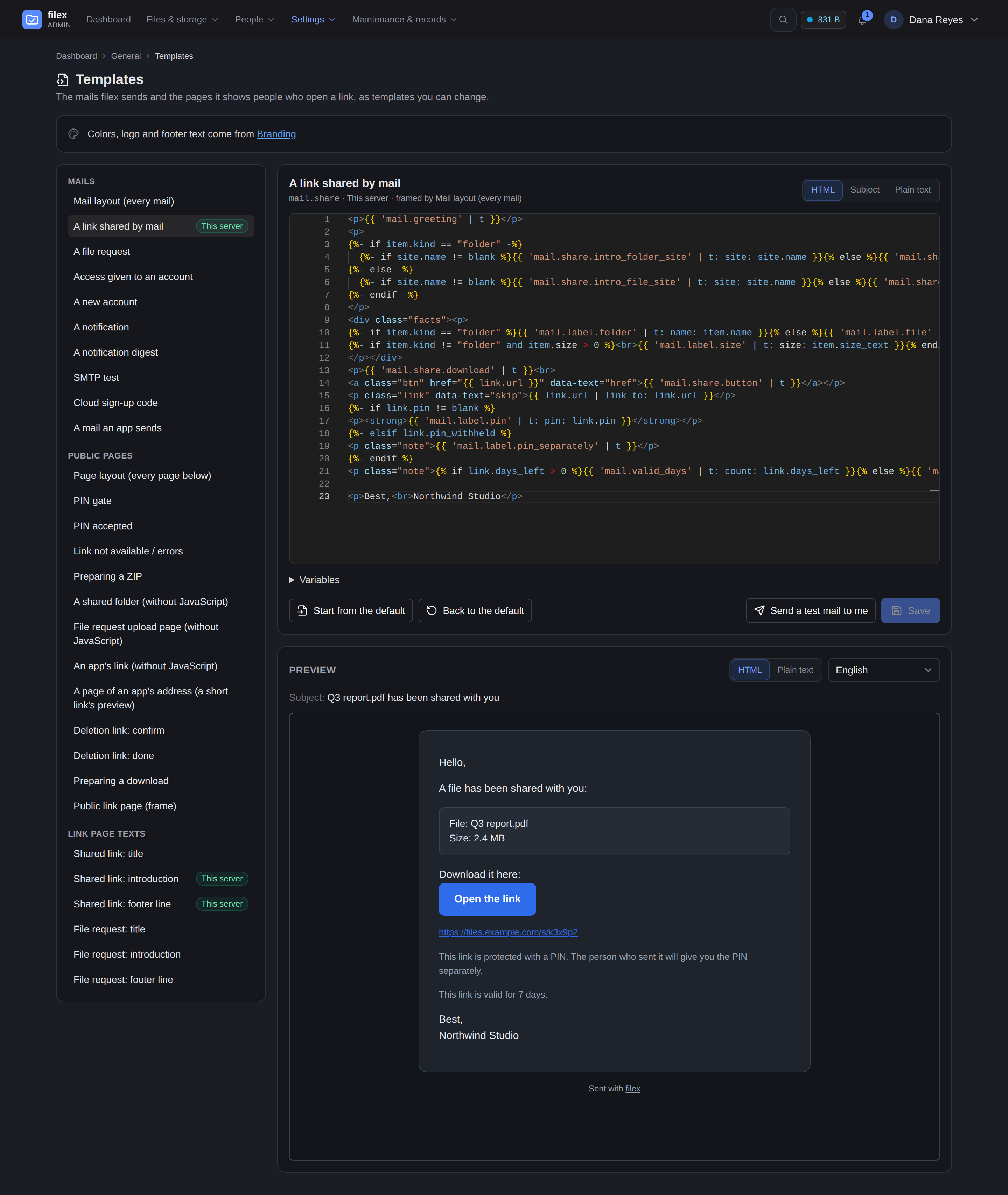
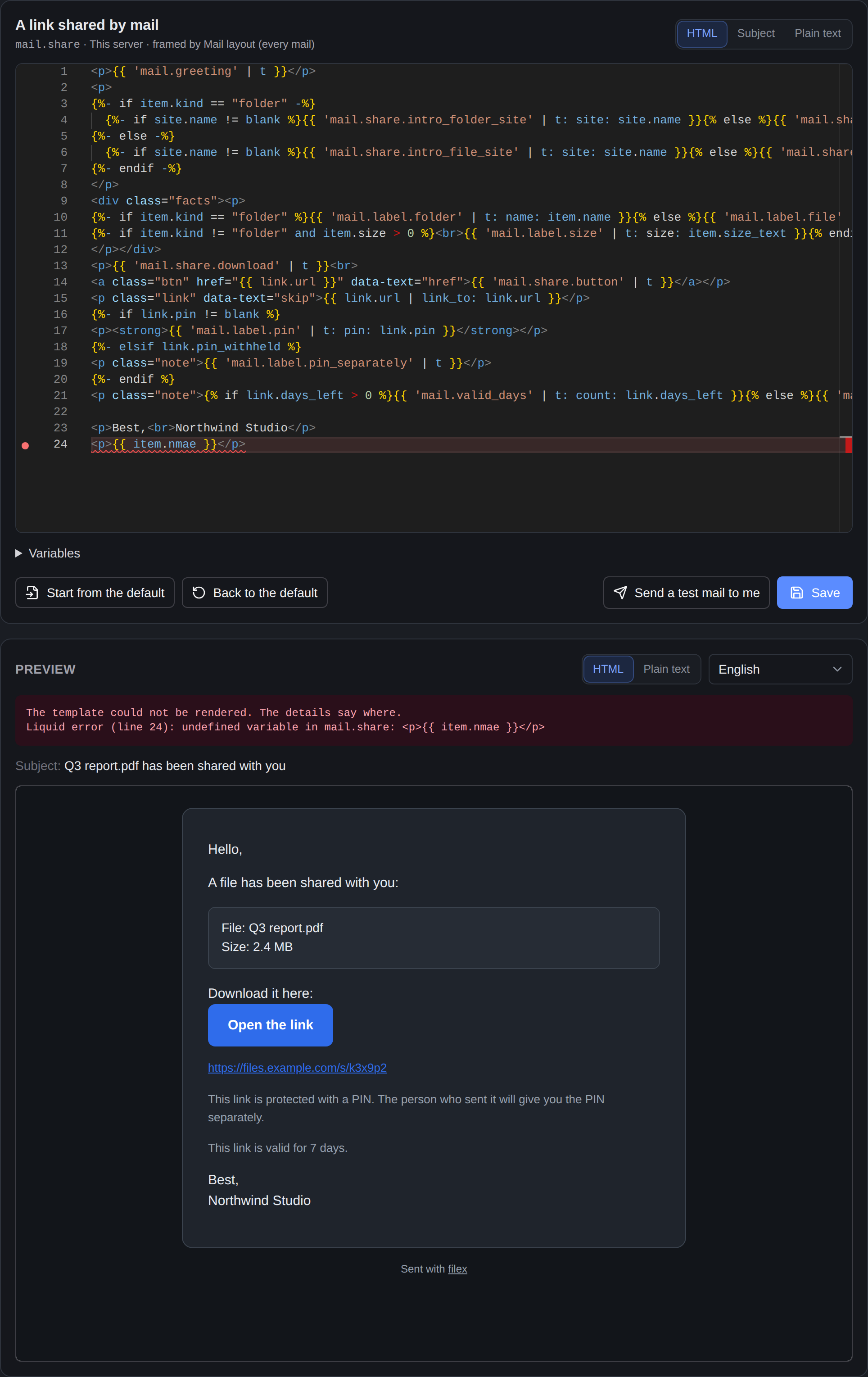
- The source is filex's code editor - the one the file preview edits code in (Monaco): Liquid and HTML in colour, line numbers, the usual keyboard (Tab indents, Ctrl+Z, Ctrl+F). When the engine refuses the draft, the line it names is marked in the editor (and scrolled into view), with the engine's words on hover and under the preview. A build of the explorer without Monaco shows a plain text box instead.
- HTML / Subject / Plain text - a mail has three parts. The plain-text part is optional: left empty, it is made from the HTML (see Mails).
- Variables - every variable the template has; click one to insert it. The hooks line names what the page's own script needs (see Hooks).
- Preview - rendered by the server, in the same sandbox the real renders use, with sample data, in the language you pick, and shown in a frame that runs no script. A mail shows its subject and both parts. What the sanitizer had to take out (a
<script>, anonclick) is listed: it will not reach anybody. - Save - checks the template first: it must render with the sample data strictly (a variable that does not exist is an error, with its line), and a page must keep its hooks. A refused save says why, in the template engine's words. Two administrators saving over each other: the second is told the template changed and opens it again.
- Start from the default puts filex's own text in the editor; Back to the default removes your text.
- Send a test mail to me sends the draft, with the sample data, to your own account's address - and only there.
If a saved template fails later anyway - a time or memory ceiling with real data, a sentence a language pack no longer has - filex uses its own template for that mail or page, the template's row shows when and why it failed, and the server's log says it too. A broken template never costs somebody their mail or a visitor their page.
Writing a template
Templates are Liquid (the osteele/liquid dialect, close to Shopify's): {{ variable }}, {% if %}, {% for %}, {% assign %}, {% capture %}, {% case %}, {% raw %}, {% comment %} and the standard filters (upcase, truncate, date, default, join, size…).
Escaping
Every {{ }} is HTML-escaped. A file name, a message, anything a stranger typed, is shown as text and never becomes markup, whatever the template does with it. There is no way around it from a template: safe does nothing. escape, escape_once, newline_to_br and capture escape exactly once (their output is not escaped a second time).
Texts from the language packs
The default templates say nothing of their own: every sentence is one of the server catalogue's (server.mail.*, server.public.*), so a language pack translates them, in the reader's language.
| Filter | What it does |
|---|---|
{{ 'mail.greeting' | t }} | A sentence, without the server. prefix. |
{{ 'mail.share.subject_file' | t: name: item.name }} | With its {placeholders} filled. |
{{ 'mail.valid_days' | t: count: link.days_left }} | count picks the plural form. |
{{ 'public.zip_hint' | t_html: link: a }} | A sentence with markup in a placeholder: the sentence is escaped, a (made by link_to) is put in as it is. |
{{ label | link_to: url, 'id' }} | An <a> around the escaped text. An address that is not http(s), mailto:, tel: or relative becomes #. |
{{ n | bytes }} | A size in the reader's language (2.4 MB). |
A sentence that does not exist is an error (the save says which). To change the words, write your own text instead of t - in one language, or in several with {% if lang == "tr" %}…{% endif %}.
blank and empty are the empty text ({% if brand.logo_url != blank %}); a list is asked with .size ({% if entries.size == 0 %}).
Hooks
Some pages run a script of filex's own - the ZIP and download progress, the upload page. The script is not part of the template (no template can carry a script, see Security); it is added after the template rendered, and it finds its way by element ids. A page template must keep them, and a save without them is refused:
| Template | Hooks |
|---|---|
page.pin | a field name="pin" in the form |
page.delete_confirm | a field name="confirm" in the form (the button's POST deletes only with it) |
page.zip_wait | #bar, #pct, #dl |
page.cache_wait | #bar, #pct |
page.file_request | #card, #sub, #drop, #hint, #file, #nameField, #uploaderName, #note, #files, #bar, #barfill, #msg, #send, #foot |
page.shell | {{ app_head }} and {{ app }}, once each |
Shared pieces
{% include 'name' %} reads only the pieces filex registers with a template; there is no file system behind it. The layouts (mail.layout, page.layout) are the way to share markup across templates.
The public link page
A browser with JavaScript opening /s/… or /d/… gets the public link page (the PIN gate with its bot check, the preview, the folder gallery, the upload, the language picker). It is an application, and three things about it are templates:
page.shellis the document it is drawn in: put your<style>(or a stylesheet<link>) in the head after{{ app_head }}, and markup of your own around{{ app }}- a header, a footer, a background.- The card is restyled by that CSS through the class names below. They are a public contract: they keep their names across releases (a test holds them; a rename would be a breaking change in the CHANGELOG).
- Text slots -
slot.share.*andslot.file_request.*: a title in place of the heading, an introduction under it and a line in the footer, rendered on the server in the visitor's language. Like the heading, the title and the introduction appear only once the link is open (after the PIN), and the item's name is given to them only then.
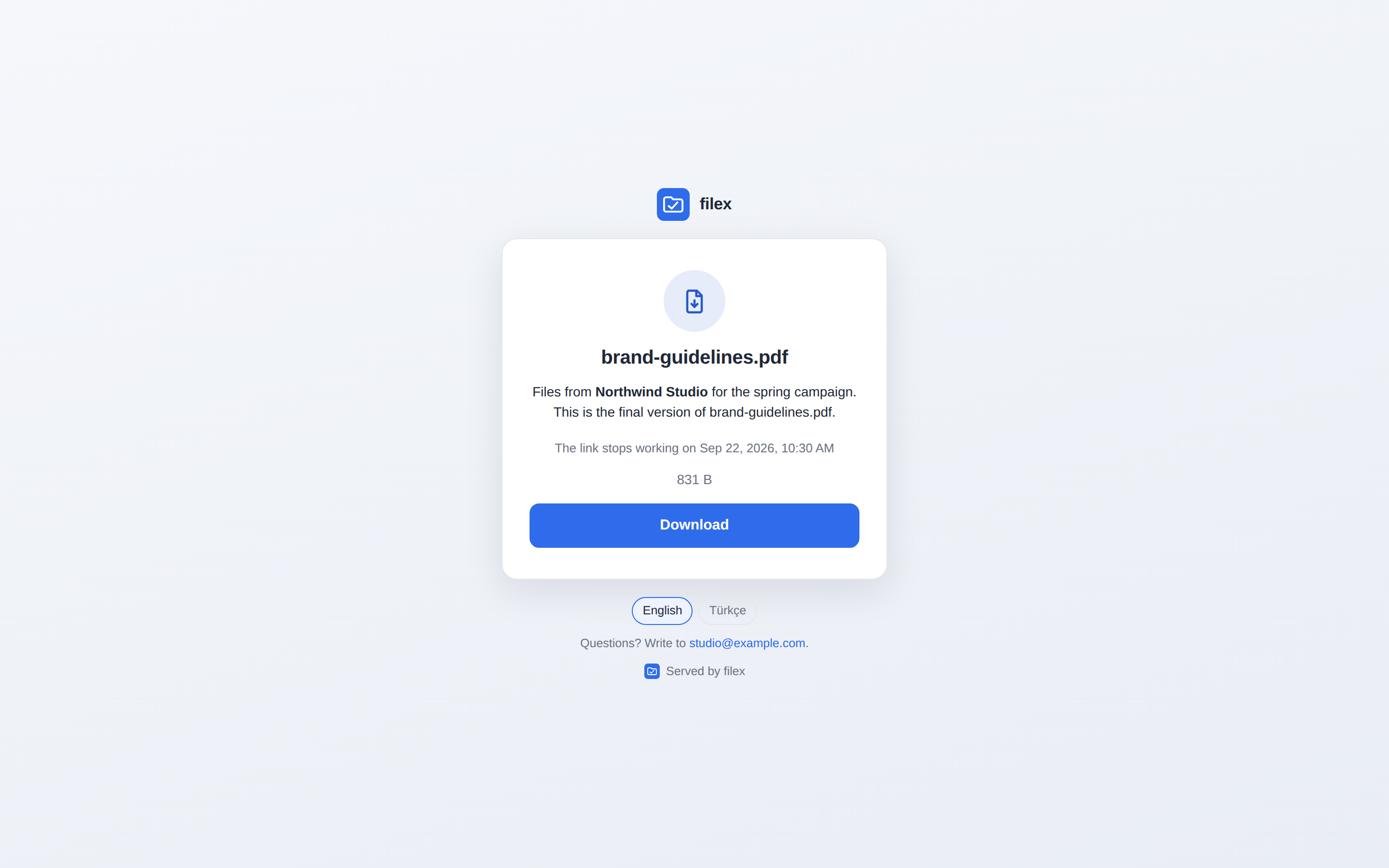
| Class | What it is |
|---|---|
.fe-ppage | The page (its root). data-state is loading, pin, ready, accepted, done, error or unavailable; data-layout is gate, form or wide. |
.fe-ppage__brand | The logo and the name above the card. |
.fe-ppage__logo | The logo. |
.fe-ppage__brandname | The name. |
.fe-ppage__card | The card. |
.fe-ppage__badge | The round badge the card opens with; .fe-ppage__badge--ok, .fe-ppage__badge--err. |
.fe-ppage__head | The heading block. |
.fe-ppage__title | The heading. |
.fe-ppage__subject | The line under it (the sender's message). |
.fe-ppage__intro | The introduction slot. |
.fe-ppage__meta | Expiry and visits left. |
.fe-ppage__slot | Every text slot (data-slot is title, intro or footer). |
.fe-ppage__pin | The PIN gate's form. |
.fe-ppage__pinput | The PIN field. |
.fe-ppage__actions | A row of buttons (download, open). |
.fe-ppage__crumbs | A folder's path. |
.fe-ppage__files | A shared folder's list. |
.fe-ppage__file | One row of it (data-dir="1" for a folder). |
.fe-ppage__entry | The row's link. |
.fe-ppage__state | A state of the page's own ("accepted", "this link is not available"); .fe-ppage__state--ok. |
.fe-ppage__state-title | Its heading. |
.fe-ppage__error | A failure, in the server's words. |
.fe-ppage__foot | The footer: the language picker, the footer text, the attribution. |
.fe-ppage__footslot | The footer slot. |
.fe-ppage__footline | The branding's footer text. |
.fe-ppage__footmark | The "Served by" line. |
An app's public address
An app can answer addresses of its own - a link shortener's /l/… on this filex's address, or a host of its own such as go.example.com (APP-PLUGINS.md → Short links). What a visitor sees there that is not a redirect is a template:
page.errorwhen the address leads nowhere (404,error.keyroute_miss), after too many tries (429,route_busy) and when the app is unavailable (503,route_unavailable). Every miss is the same page, whatever the reason, so it says nothing about why.page.routewhen the app answers with a page, such as a short link followed by+(where it goes, and a button to go there). The app gives words - a title, a text, a web address and its label - never HTML.
Both are put in page.layout and wear the address's templates and branding: a host of its own is its tenant's, filex's own address the tenant of the host the visit arrived on.
They load nothing from anywhere. A host of the app's own serves the app's addresses and /healthz, nothing else of filex, so these pages are served with a Content-Security-Policy of default-src 'none' (inline styles only, no image, font or stylesheet from any address, no form, no frame) and drawn without the brand's logo: brand.logo_url is empty in them, and the default layout then shows the brand's name. The theme (theme.css) is inline and stays. An edited template may name an image or a stylesheet; the browser does not fetch it.
They are drawn once and served again. A flood of guesses is made of exactly these answers, and an edited template renders in the sandbox, filex's dearest render: each page is drawn once per language, kind and tenant (an app's page once per its words) and served again for a minute, compressed for a browser that takes gzip. A template saved in the editor shows at once on the server it was saved on; another replica of filex picks it up within that minute, as it does a language pack's new wording.
Mails
A mail is sent as multipart/alternative: a plain-text part and the HTML part, both quoted-printable (no line over SMTP's limit), with Date, Message-ID and Content-Language headers.
- The CSS is written into the elements. Several mail programs drop
<style>, so every rule of the template's stylesheets that can apply to an element is put in itsstyleattribute, by specificity, as a browser would. What cannot be -@media(dark mode, a narrow screen),:hover- stays in a<style>for the programs that read one; a<style data-inline="keep">is left as written. - The plain text is made from the HTML unless the template has a plain-text body of its own: paragraphs,
-list items, a link followed by its address. Two attributes say what the HTML means in plain text:data-text="skip"leaves an element out (an address under a button would be said twice), anddata-text="href"on a link writes its address alone. - The language is the reader's: an account's own, else the one picked for the address in the form, else the install's default.
- Images in a mail need an absolute
https://address; a logo given as adata:URI is shown by few mail programs (the default layout then shows the name).
Security
Templates are written by administrators - on a multi-tenant install, by the administrator of any tenant - and the pages are opened by strangers, on the same address as everybody's sessions. So:
- No template can run a script, for anybody (the install's administrator included). What a template renders passes a sanitizer that removes
<script>,<iframe>,<object>,<embed>,<base>, event handlers (on…),javascript:and other script addresses,<meta http-equiv>, SVG animation, and a form posting elsewhere. Every page is then served with a Content-Security-Policy whosescript-srcis a nonce made for that response and given to filex's own script alone,form-action 'self', and no frame,<object>or<base>(the public link page: that nonce and'strict-dynamic',base-uri 'self', andobject-src 'self'for a PDF's preview). The text slots are sanitized again in the browser before the page draws them. - An edited template runs in a sandbox. Liquid has loops and string building, and no Go Liquid library bounds them: measured,
{% for i in (1..100000000) %}{% endfor %}ran past every deadline in-process and a string doubled thirty times asked for ten gigabytes. Every template an administrator saved is rendered in a WebAssembly instance (the same engine compiled towasip1, in wazero): a fresh instance per render, at most 64 MiB of memory, 1 s for a page and 3 s for a mail, 1 MiB of output, two at a time, no file and no network. A template that reaches a ceiling, or fails at all, is replaced by filex's own for that render. filex's own templates are part of the program and render in-process. - Templates are 128 KiB at most, and
includereads only registered pieces (the library's default would read files from the server's working directory). - Tenants are kept apart: a tenant's templates are read and written with its id, set from the session; the cache of rendered pages is keyed by template revision and the whole of the data.
The sandbox's module (backend/internal/templates/sandbox/engine.wasm.gz) is built from the repository by a pinned, reproducible Docker build (sh backend/internal/templates/sandbox/build.sh); a test is red when the sources changed and the module was not rebuilt.
API
/api/admin/templates (an administrator; the scope is the session's):
| Call | What it does |
|---|---|
GET /api/admin/templates | Every template: kind, layout, hooks, variables, whose text is in force (source: tenant, instance, default), its revision and last failure. |
GET /api/admin/templates/{key} | One template: the text in force for you, and filex's own. |
PUT /api/admin/templates/{key} | Save {subject, body, text, revision} (the revision you opened; 409 template_changed when somebody saved in between). Refused with 422 template_invalid, template_hooks_missing, template_too_slow or template_stopped (a ceiling of the sandbox) and the engine's words, 413 template_too_large over 128 KiB. |
DELETE /api/admin/templates/{key} | Back to the default. |
POST /api/admin/templates/{key}/preview | Render a draft {subject, body, text, lang} with sample data. |
POST /api/admin/templates/{key}/test | Send it to your own address. |
The public link page reads its slots from GET /api/public/s/{token}/slots and GET /api/public/d/{token}/slots (in the visitor's Accept-Language), and its identity from GET /api/public/s/{token}/branding and GET /api/public/d/{token}/branding: the link's tenant's branding, or the address's for a token that names no live link (BACKEND.md).
Saves, resets and test mails are in the audit log (template.update, template.reset, template.test). The templates are kept in the templates table (migration 00137).