
Storage plugins
filex speaks local disk, S3, SFTP, FTP, WebDAV and SMB out of the box. A plugin is how it speaks to something it has never heard of: your appliance, your company's object store, a research archive with its own API — anything that can list, read and (optionally) write files.
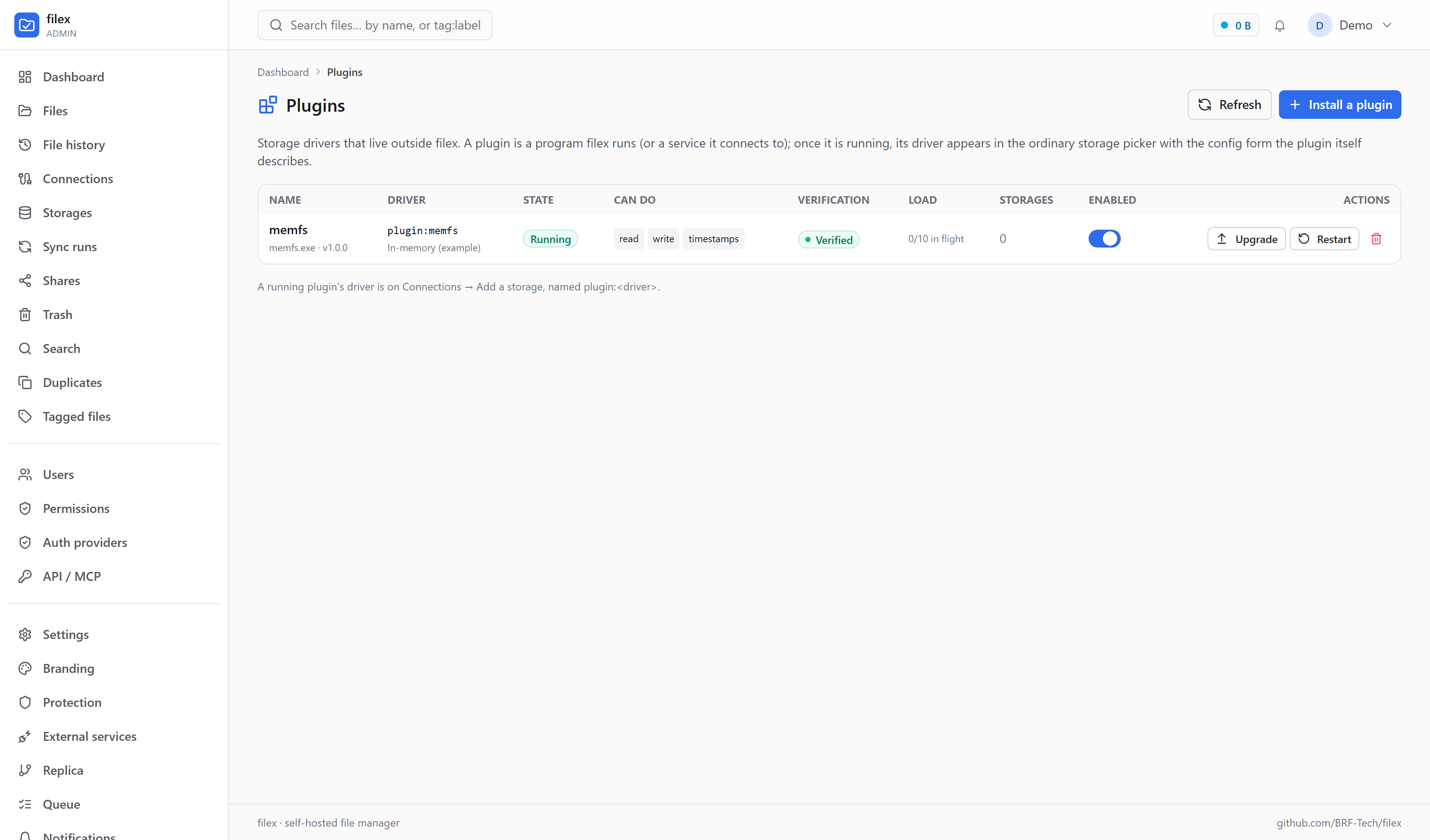
A plugin is a separate program. filex starts it and talks to it over a small HTTP/JSON protocol, so a plugin can be written in any language, ships on its own schedule, and cannot take filex down when it crashes. Once it is running, its driver appears in the ordinary storage picker with the config form the plugin itself describes — nothing about filex's frontend or its release cycle is involved.
What a plugin claims is not taken on trust. Every capability it declares is probed before anybody can build a storage on it, and again against the configuration an operator types — see Conformance. A plugin that fails its own claims is refused, because a half-working driver produces failures the user reads as filex being broken.
Admin → Plugins → Install          Connections → Add a storage
        ┌──────────────┐                  ┌────────────────────┐
        │ your program │◀── HTTP/JSON ────│ filex              │
        │  (any lang)  │   unix socket    │  storage.Driver    │
        └──────────────┘   or loopback    └────────────────────┘
Install one
Admin → Plugins → Install a plugin, in one of three ways:
| Source | What happens | When to use it |
|---|---|---|
| Upload a binary | The file is stored under <data-dir>/plugins/<name>/, hashed, and launched. | The normal case. |
| From a URL | Downloaded, checked against a required SHA256, then as above. | Unattended installs, scripted setups. |
| Remote service | Nothing is launched: filex connects to an address you give it with a bearer token you give it. | A sidecar container, a plugin on another host, or a plugin you are developing. |
⚠ A plugin runs with filex's own privileges and is handed the credentials of every storage created on it. Install only plugins you trust — the same judgement you would apply to a package you install on the server.
⚠ The binary has to be built for the server, not for your laptop:
GOOS=linux GOARCH=amd64for the usual Docker image. A binary for the wrong platform fails to start, and the Plugins page shows the exec error.
Installing does not end at "the file is on disk". filex starts the plugin, asks it to describe itself, and then probes every capability it declared against a throwaway area the plugin opens for exactly that (POST /v1/selftest). Only then is the driver registered. A plugin that fails a probe never reaches running — it lands in Refused, and the page shows the report: which probe failed, what was expected, what happened.
⚠ The install call answers 201 before any of that has happened — describe and the probes run after the row exists. A script that treats the 201 as success will happily report a plugin installed that filex has already refused; read the state from
GET /api/admin/plugins.
A plugin that offers no /v1/selftest is still installed, but it is unverified: nothing was proven at install, and the same probes run when somebody saves the first storage on it. The Plugins page says which of the two you are looking at, because "verified" and "not yet probed" are different statements and only one of them is a promise.
The name you choose ([a-z0-9][a-z0-9_-]{0,31}) names the plugin's folder and appears in logs. The driver name comes from the plugin itself, and the storage driver is always plugin:<driver> — a plugin can never shadow a built-in driver, and two plugins cannot claim the same one (the second is refused, naming the first).
To turn the subsystem off entirely: FILEX_PLUGINS_DISABLED=1. Nothing is launched, no remote is contacted, and the admin API answers 503 saying so. In multi-tenant mode the page is supertenant-only: a tenant admin gets a 403 that says whose surface it is.
States
| State | Meaning |
|---|---|
| Running | Described itself, driver registered, storages can open. |
| Starting… | Launched; the handshake or describe has not finished. |
| Failed | Exited or became unreachable. A binary is restarted with backoff; a remote is re-checked every few seconds. |
| Refused | filex will not use it: protocol mismatch, an invalid describe, a driver-name collision, a binary whose SHA256 no longer matches what was installed, a missing or bad signature where one is required, or conformance failure — it declared a capability it could not perform. state_error carries the reason. Fix it and press Restart. |
| Off | Disabled by the toggle. The driver is unregistered, and storages on it stop opening. |
Removing a plugin deletes its files and its registration. Storages created on it are left alone — they simply cannot open until the plugin is back. Deleting somebody's storages is not a decision this button makes; the page shows how many will be affected before you confirm.
Upgrading replaces the binary and keeps everything else — see Upgrade in place. Do not remove-then-install to get a new version: removing takes the registration with it, and a storage whose driver has gone is a storage that cannot open.
Conformance: a plugin has to prove its claims
A plugin declares its capabilities and filex acts on them — it registers a driver whose method set matches, and every surface then offers those operations. If the plugin declared write and its write is broken, the user meets an upload button that fails, a trash move that fails and a version snapshot that fails, and reads all three as filex being broken. The plugin is the faulty part; the product wears the fault.
So each declared capability is measured, in two places:
| Gate | When | Against what |
|---|---|---|
| Self-test | at install, and every time the plugin starts | a throwaway instance the plugin opens for POST /v1/selftest |
| Storage save | when a storage on the plugin is created or edited | that storage's real configuration, in a scratch folder that is removed afterwards |
The second gate exists because the first cannot cover it. A self-test proves the plugin's code works; it cannot prove that these credentials reach that bucket, that this path exists, or that the account may write there. Finding that out when the storage is saved costs one error message; finding out later costs a user who uploads a file into a storage that cannot hold it.
What runs, in order: list · not_found · write · read (bytes compared) · stat (size and kind must agree with what was written) · list_after_write · range (bytes 8–17 must be those bytes) · set_mtime (set, then re-stat — a timestamp that is accepted and dropped makes every sync run copy everything again) · copy · move (the source must be gone afterwards) · mkdir · delete · delete_idempotent (deleting what is already gone must be a no-op — trash purge, sync and the ops worker all rely on that) · presign · multipart (one part, uploaded, completed, read back and compared) · watch. A capability that was not declared is reported as skipped, not passed.
⚠ list short-circuits: a backend that cannot list is not probed further, because every later probe would fail with the same cause and bury it.
⚠⚠ What conformance cannot check is worth knowing before you rely on it:
presignis verified to return an absolute URL that parses, not one a browser on another network can reach. filex may not share the client's network, so it deliberately does not fetch it — a plugin that hands back a loopback URL passes the probe and fails in every browser.watchis verified to open a stream, not to deliver an event for every change. Requiring an event would mean requiring the plugin to notice a change filex made inside a ten-second window, which a polling backend legitimately cannot.- Nothing here separates a slow backend from a broken one beyond the timeout (90 s for a whole run; the storage-save gate gives the whole check 2 minutes).
⚠ The storage-side probes write into your storage: a folder named .filex-conformance-<random> at the storage root, removed when the run finishes. If you find one left behind, that is the report — a plugin whose delete is broken is exactly what the delete probe catches. A read-only plugin creates nothing: its probes list and stat at the root and say plainly that the write half was not exercised.
Modes
FILEX_PLUGIN_CONFORMANCE — enforce (default) · warn · off.
| Mode | A plugin that fails its own claims |
|---|---|
enforce | is refused, and a storage cannot be saved on it. |
warn | is registered anyway; the report is kept and shown. For somebody writing a plugin — never the default, because the cost of a broken claim is paid by the user. |
off | is not probed at all. Both gates are skipped. |
The mode is reported by the admin API and shown on the page, so nobody has to discover that the safety net is down by meeting a broken storage.
⚠ Built-in drivers are not put through this. They are compiled in, covered by the repository's own tests, and already have a connection test; probing every storage save would change behaviour for paths that never had this problem.
Upgrade in place
POST /api/admin/plugins/{id}/upgrade — multipart, file (and signature when this instance requires one). Admin → Plugins → Upgrade does the same thing.
The row, the name, the driver and every storage built on it survive. What happens, in order: stop the plugin, put the new file in place, start it, run the conformance gate. If the new binary does not come up — a bad build, a wrong architecture, a capability it can no longer perform — the previous binary is restored and started again, and the call answers 400 with both the failure and the plugin's current status. A failed upgrade costs an error message, not a plugin.
⚠ The plugin is stopped first, deliberately. A running executable cannot be replaced on Linux (
ETXTBSY), and a plugin serving requests should not have the ground moved under it. Storages on it fail for the length of the swap; they recover on their own when it comes back.
⚠ Only a binary plugin can be upgraded this way. A remote plugin is upgraded where it runs — filex only holds its address.
Signed plugins
filex can require that a plugin binary is signed before it will accept it. Configure trusted ed25519 public keys (hex or standard base64) in FILEX_PLUGIN_TRUSTED_KEYS (comma-separated), or on the plugin manager's Options.TrustedKeys if you embed filex; when at least one key is present, install and upgrade both refuse an unsigned or badly signed binary, and the admin API reports requires_signature: true so the UI can ask for the signature up front rather than after a rejection.
What is signed is the binary's sha256, hex-encoded and lower-cased — not the file itself. That keeps verification cheap and lets you sign the same digest you already publish:
sha256sum myfs | cut -d' ' -f1 | tr -d '\n' > myfs.sha256
# sign the CONTENTS of myfs.sha256 with your ed25519 key; send the detached
# signature (hex or base64) as the `signature` field alongside the upload
⚠ A checksum and a signature answer different questions. The SHA256 an install already requires only proves the file has not changed since it arrived; it says nothing about who it came from. That is the whole reason this exists.
FILEX_PLUGIN_TRUSTED_KEYS=3d40…e91b,7ac2… filex serve⚠ Enforcement is off until a key is set — which is the honest default for a single-admin instance, and the wrong one for a shared server where "admin" is several people. Setting one key changes nothing about plugins already installed; it applies from the next install or upgrade.
⚠ Rotation is why the setting takes a list: any one trusted key verifying is enough, so a new key can be added before the old one is retired.
⚠⚠ A public demo must not offer this
An instance running with FILEX_DEMO_MODE publishes an admin login. The plugin API is admin-only, so on that one instance "admin-only" means anybody — and installing a plugin makes filex execute an uploaded program on the host.
So demo mode turns the subsystem off by default. FILEX_PLUGINS_DISABLED=0 overrides it, deliberately, for somebody who knows what they are handing out.
This default came from a measurement rather than a worry. On 2026-08-19 the project's own public demo was checked: the credentials printed on its landing page logged in as
role=admin, andGET /api/admin/pluginsanswered200. Nothing had been installed — and nothing was stopping it. A safe state that depends on the operator noticing is not a default.
The same reasoning is why the surface is supertenant-only in multi-tenant mode: a tenant admin administers their tenant, not the machine — and why a demo also refuses the local storage driver, which is the other way to reach the host's filesystem from an admin session (STORAGE.md).
What a plugin may cost filex
A plugin is somebody else's program in filex's request path. Without ceilings, one slow plugin is one slow filex.
| Bound | Value | Why |
|---|---|---|
| Concurrent operations, per plugin | 10, FILEX_PLUGIN_MAX_INFLIGHT | Comfortably above what a browsing user generates; low enough that a stuck plugin cannot consume the server. |
| Waiting for a slot | 5 s, then refused | If every slot is busy the honest answer is "this storage is overloaded", not a request that hangs for a minute and fails anyway. |
| Metadata operations | 60 s | list, stat, delete, mkdir, move, copy, set_mtime. Slowness there means trouble. |
| Reads and writes | no timeout | A 20 GB upload is legitimately slow; a deadline would turn a working transfer into a failed one. |
| Lifetime | bound to filex's | A plugin must not outlive its supervisor. Unix: a process group, so a helper the plugin forked goes with it. Windows: a job object with KILL_ON_JOB_CLOSE, which the kernel enforces even when filex is killed outright — measured, because otherwise the orphan holds its own .exe open and the next upgrade of that plugin fails. |
| Plugin stdout/stderr | 50 lines/s, burst 200 | A chatty debug build or a tight retry loop is otherwise filex filling the disk. Dropped lines are reported, once per window, rather than silently lost. |
A refusal is counted separately from a failure (outcome="busy", see METRICS.md): saturation is a sizing problem, not a bug to chase. Conformance probes are exempt from the ceiling — a probe must not be refused because users are keeping the plugin busy.
⚠⚠ filex is not a sandbox, and does not pretend to be one. A plugin runs as filex's own user with filex's own privileges. On Linux and macOS it is put in its own process group, so a helper it spawned (an
rclone, a mount, anssh) is killed with it instead of surviving to hold the socket — which is the failure that looks like "the plugin is stopped but the next start says address already in use". Memory and file-descriptor limits are not set: Go cannot apply an rlimit to a child between fork and exec, and setting one in the parent would cap filex itself. On Windows there is no process group in the POSIX sense, so a helper a plugin spawned outlives a plugin stop or restart there, and dies only when filex itself exits and the job object above closes. Real isolation means namespaces, seccomp or a container runtime — run the plugin as a remote service in its own container if you need that.
A plugin storage is a storage everywhere
A plugin driver is not a second-class mount. The same storage is served over WebDAV, SFTP, FTPS, NFS and the S3 endpoint (PROTOCOLS.md), gets thumbnails, is walked by the sync worker, and counts against quota — each of those has its own test against a live plugin in this repository, so none of it is an assumption.
Two behaviours are worth stating because they are the ones that would hurt:
- ⚠⚠ An unavailable plugin is an error, never an empty listing. A
PROPFINDagainst a storage whose plugin is down answers a failure, not200 OKwith nothing in it — a mirroring client that saw the second one would delete the user's local copy. The storage recovers on its own when the plugin answers again: no filex restart, no re-saving the connection. - ⚠⚠ A plugin outage does not wipe the index. The sync run fails, is recorded as
failed, and the nodes stay; the next healthy pass adds nothing because nothing was lost. A read-only plugin refuses writes on every one of those surfaces, not just in the web UI.
Write one (Go)
The SDK makes a plugin three methods and a Serve call. Everything else — handshake, routing, streaming, error codes, instance bookkeeping — is done for you.
package main

import (
	"context"
	"io"
	"os"

	"github.com/brf-tech/filex/backend/pkg/pluginsdk"
)

type myFS struct{ root string }

func (m *myFS) List(ctx context.Context, path string) ([]pluginsdk.Object, error) { /* … */ }
func (m *myFS) Stat(ctx context.Context, path string) (pluginsdk.Object, error)   { /* … */ }
func (m *myFS) Read(ctx context.Context, path string) (io.ReadCloser, error)      { /* … */ }

func main() {
	pluginsdk.Serve(pluginsdk.Plugin[*myFS]{
		Name:    "myfs",
		Version: "1.0.0",
		Label:   "My storage",
		Fields: []pluginsdk.Field{
			{Key: "root", Type: pluginsdk.FieldString, Label: "Root", Required: true, Root: true},
			{Key: "token", Type: pluginsdk.FieldPassword, Label: "API token", Secret: true},
		},
		Open: func(ctx context.Context, cfg map[string]any) (*myFS, error) {
			return &myFS{root: pluginsdk.String(cfg, "root")}, nil
		},
		// Scratch space filex may write to and delete, for the conformance
		// probes. Without it the plugin is registered UNVERIFIED and the
		// probes fall on somebody's first real storage instead.
		SelfTest: func(ctx context.Context) (*myFS, error) {
			dir, err := os.MkdirTemp("", "myfs-selftest-")
			if err != nil {
				return nil, err
			}
			return &myFS{root: dir}, nil
		},
	})
}
Two complete, working examples live in the repository, and filex's own tests install and drive them, so neither can rot:
backend/examples/plugin-memfs— the Go SDK in a single short file, in-memory, with aSelfTestarea.backend/examples/plugin-diskfs/plugin.py— Python, standard library only, no SDK: the same protocol implemented by hand, backed by a real directory, with every optional capability (ranged reads, move, copy, mkdir, mtimes, the change stream,/v1/selftestand multipart). It exists because “any language” is a claim worth proving rather than repeating; itsacceptance.shdrives the whole subsystem — conformance, a plugin that lies, multipart, upgrade and rollback — through filex's own admin API.
go build -o myfs ./cmd/myfs      # for the SERVER's platform
# Admin → Plugins → Install → upload `myfs`
Capabilities are your method set
Add a method, gain a capability. There is no list to keep in step:
| Implement | filex gains | If you don't |
|---|---|---|
Write and Delete | uploads, rename, trash, versions | the storage is read-only everywhere in the UI |
RangeReader | ranged reads (video seek, partial downloads) | filex reads from the start and discards — correct, just slower |
Mover / Copier | server-side move / copy | emulated as copy+delete / read+write |
Mkdirer | real directories | treated like an object store: a no-op |
Toucher | a file's own mtime survives a sync | filex does not offer it (better than pretending) |
Watcher | event-driven sync instead of a poll, on a storage set to fsnotify | filex polls on its sync interval |
Presigner | share downloads redirect the visitor to your URL — the bytes never pass through filex | filex streams them from your plugin |
Multipart (needs Writer) | resumable uploads: the staged-upload commit pushes parts instead of one long PUT | filex writes the whole object in one Write |
⚠
WriteandDeletetravel together. A driver that can create files it cannot remove breaks trash and versioning, so filex refuses the pair split at registration — and the SDK reports the pair honestly rather than letting you discover it later.multipartwithout the pair is refused for the same reason: a resumable upload is still an upload.
⚠ Exactly one field should be marked
Root: true— the field that scopes a storage inside your backend (a path, a prefix, a bucket). filex refuses to mount a backend's root, so a plugin without one has every storage rejected.
⚠
SelfTestis optional and you want it. It is a backend over scratch space you are happy to have written to and deleted (a temp directory, a throwaway prefix, an in-memory area); filex releases it withDELETE /v1/instances/{id}when the probes are done. Skip it and your plugin is installed unverified, and the first person to save a storage on it runs the probes for you.
⚠⚠ Only declare
presignwhen the URL works from the client's network. Conformance can only check that a URL comes back and parses — filex may sit on a network the browser cannot see, so it will not fetch it for you. A plugin that returns a loopback URL passes the probe and then breaks every share download on that storage.
⚠
Watcheris now consumed, on a storage whose sync mode isfsnotifyand whose driver is not local (see below). The previous release's docs said "nothing yet" and were right at the time; the endpoint is no longer decoration.
⚠ Return the SDK's errors —
pluginsdk.ErrNotFound,ErrReadOnly,ErrUnsupported. They become filex's ownstorage.ErrNotFoundand friends, so a missing file answers 404 rather than 500. The conformance run tests this directly:Staton a path that does not exist must map tonot_found, or the probe fails and the plugin is refused — a 500 where a 404 belongs is how a missing file turns into "filex is broken".
watch: what filex does with your change stream
A storage set to sync_mode: fsnotify uses, in this order:
- inotify, when the driver is local — cheaper, and it sees changes made outside filex on the same disk;
- your stream, when the driver implements
Watcher— filex subscribes to/v1/instances/{id}/watchand re-scans on your events; - polling, when there is neither.
Events are coalesced (2 s debounce, the same as the inotify loop, so an unpacking archive is one scan rather than one per file) and each batch triggers the same full run a poll would. A missed or duplicated event therefore costs a scan, never a wrong index: your stream is a hint about when, not a ledger of what.
⚠ A stream that ends is not the end of the storage. When your plugin restarts or the connection drops, filex logs it and falls back to polling rather than leaving the storage frozen with a stale index — the failure that would otherwise look like "filex stopped seeing my files".
⚠ The initial scan still happens. The stream makes the index current sooner; the scan is what makes it true.
Developing against a running filex
Run the plugin yourself and register it as a remote plugin, so a rebuild is a restart of your own process:
FILEX_PLUGIN_TOKEN=dev-token FILEX_PLUGIN_LISTEN=127.0.0.1:9099 go run ./cmd/myfs
# Admin → Plugins → Install → Remote service
#   Address: http://127.0.0.1:9099   Token: dev-token
While a capability is half-finished, run that filex with FILEX_PLUGIN_CONFORMANCE=warn: the probes still run and the report still appears, but a failure no longer refuses the plugin. Put it back to enforce before anyone else uses the instance — the point of the gate is that the person who pays for a broken claim is the user, not you.
The protocol (any language)
filex sets two environment variables and reads one line on stdout:
FILEX_PLUGIN_TOKEN=<32-byte hex>     the bearer token on every request
FILEX_PLUGIN_SOCKET_DIR=<dir>        a private directory you may create a socket in

→ stdout: FILEX-PLUGIN/1 unix:/path/to.sock
      or: FILEX-PLUGIN/1 tcp:127.0.0.1:PORT
Everything after that is HTTP with Authorization: Bearer <token>:
| Method | Path | Body / notes |
|---|---|---|
GET | /v1/describe | {protocol, name, version, label, fields[], capabilities{}} |
POST | /v1/instances | {config} → {instance} — one per storage row |
DELETE | /v1/instances/{id} | release it |
GET | /v1/instances/{id}/list?path= | {objects: [...]} |
GET | /v1/instances/{id}/stat?path= | one object |
GET | /v1/instances/{id}/read?path= | the bytes; honours Range when you declare range |
PUT | /v1/instances/{id}/write?path= | the bytes; X-Filex-Size carries the length (-1 = unknown) |
POST | /v1/instances/{id}/move · /copy | {src, dst} |
POST | /v1/instances/{id}/delete · /mkdir | {path} |
POST | /v1/instances/{id}/set-mtime | {path, mtime} (RFC 3339) |
GET | /v1/instances/{id}/watch | text/event-stream of {op, path, from}, when you declare watch |
POST | /v1/selftest | → {instance} — a throwaway instance for the conformance probes. No config; back it with scratch space you are happy to lose. Answer 404/unsupported if you have none: the plugin is then registered unverified. |
POST | /v1/instances/{id}/presign-upload | {path, size} → {url, method?, headers?, expires_at} (presign) |
POST | /v1/instances/{id}/presign-download | {path, ttl_s} → {url, expires_at} (presign) |
POST | /v1/instances/{id}/multipart/init | {path, total_size, part_count} → {upload_id, part_urls?} (multipart) |
PUT | /v1/instances/{id}/multipart/part?upload_id=&part=N&path= | the part's bytes (X-Filex-Size) → {etag} |
POST | /v1/instances/{id}/multipart/complete | {path, upload_id, parts:[{part_number, etag}]} |
POST | /v1/instances/{id}/multipart/abort | {path, upload_id} |
⚠⚠ What your objects report decides how often filex re-reads them. The storage sync compares the object's
etagwhen you return one, and its size and modification time to the second when you do not — that is howlocal,sftp,smbandftpwork too. So a plugin whose mtime jitters (a backend that reports the access time, or one that rounds differently on every call) reports drift on every file on every pass: the catalogue is rewritten, the content is re-extracted, and on an install with antivirus on, the entire storage is re-scanned every sync interval, forever. Return a stable etag if the backend has one; if it does not, make sure the mtime you report for an unchanged object does not move.
⚠
multipart/partis one route with a slash in it, notmultipartwith a sub-resource. Splitting the path and switching on the first segment alone makes every multipart call answer 404 — which is what the Python example did until conformance caught it.
⚠
part_urlsis for the browser-chunked upload endpoint (POST /api/files/upload/init), which hands them straight to the client. The path that actually exercises a plugin's multipart today is the staged upload commit, and it holds the bytes itself, so it pushes each part throughmultipart/partand ignorespart_urls. Returning none is normal.
Errors are {"error": <code>, "message": <text>}. Codes filex understands: not_found, read_only, unsupported, invalid, and no_instance — answer that one for an id you do not recognise and filex re-creates the instance from the saved config and retries the call once. That is what makes a plugin restart invisible to the person using the file manager.
⚠
multipart/partis the one call that is not retried. A part body can be read only once, and a plugin that lost its instance has also lost the upload the part belongs to — retrying would land a part in a different upload. The caller starts the upload again instead.
⚠ If you serve
/watch, flush the response headers immediately. Written but unflushed headers leave filex waiting for a response that has already been produced — a watch that appears to hang on an idle backend.
⚠ A plugin that listens on TCP must bind loopback. The token is the only thing between the world and the storage credentials filex sends you; filex refuses a handshake that advertises a non-loopback address.
Where things live
| What | Where |
|---|---|
| Installed binaries | <data-dir>/plugins/<name>/ |
| Sockets a plugin creates | <data-dir>/plugins/<name>/run/ (mode 0600) |
| Registration | the plugins table (migration 00029) |
| A remote plugin's token | sealed with FILEX_SECRET_KEY — registering one without that key is refused rather than stored in plaintext |
| The previous binary, during an upgrade | <data-dir>/plugins/<name>/<binary>.previous, removed once the new one is up (and used to roll back when it is not) |
| Conformance probe leftovers | .filex-conformance-<random>/ at a storage's root — named so an operator who finds one knows what made it |
| Host implementation | backend/internal/plugin |
| Driver shapes | internal/plugin/driver_shapes.go — generated, 20 combinations: go run ./internal/plugin/gen > internal/plugin/driver_shapes.go. ⚠ Regenerate it after touching the generator: TestGeneratedShapesAreCurrent runs the generator and fails CI when the file differs (it skips under go test -short) |
| SDK | backend/pkg/pluginsdk |
| Metrics | filex_plugin_* — see METRICS.md |
⚠ Why the shapes are generated rather than written: filex decides what a storage can do by type-asserting optional interfaces wherever an operation needs one, so a plugin that cannot write must be handed to filex as a value with no
Writemethod — not one that returns an error, or the UI offers an upload button that fails at the last moment. With five optional axes (write, mtime, watch, presign, multipart) that is twenty structs, and twenty hand-written structs is where somebody eventually embeds the wrong thing and a read-only plugin quietly becomes writable.
Related: STORAGE.md for the built-in drivers, CONFIGURATION.md for the environment variables, METRICS.md for what to watch, BACKEND.md for the admin API, and PROTOCOLS.md for reaching filex from other clients (the opposite direction).