
End-to-end encrypted folders
A folder in filex can be made end-to-end encrypted: its files are encrypted and decrypted in the browser with WebCrypto, and no password or key is ever sent to the server. The server stores opaque blobs it cannot read and does not participate in the crypto at all.
This page is the reference for that feature — the threat model, the key hierarchy, the on-disk formats, which parts of filex stop working inside such a folder, and the ways you can still end up with plaintext on the server.
⚠ Recovery is limited and deliberate. A folder created from v0.31 on has a user recovery key, shown once at creation and never stored by filex. Lose both the password and that key and the files are gone — nobody can restore them. Folders created before v0.31 have no recovery key until you add one; see Folders created before v0.31.
- Threat model — what it protects · what it does not hide
- Key management — folder marker · file format
- Recovery — user recovery key · key escrow · adopting escrow later · offering an existing folder a slot · what escrow cannot do · before v0.31
- Feature trade-offs
- Ways plaintext still reaches the server
- Using it
- What the server knows
- Not implemented
- See also
Threat model
What it protects
The contents of the files inside the folder. An attacker holding the server disk, the S3 bucket, a database backup, a stolen host, or a legal seizure order gets ciphertext. So does filex itself. Encryption and decryption happen only in the browser; the server sees a blob that starts with the filexe2e magic and nothing else.
⚠ The server operator is in that list only while key escrow is off — which is the default. When escrow is on, the operator holds a key to every folder created since, and a stolen server still yields nothing because the escrow private key is not on it.
⚠ Escrow can be turned on later, on an installation that already has folders — see adopting escrow. It takes a deliberate act by the operator, it is recorded with a timestamp, and it reaches only folders created after it. A folder you created while escrow was off stays outside the operator's reach; no configuration change, admin action or future version of filex takes it.
⚠ You can hand it over, and only you can. The next time you unlock such a folder, filex offers to seal it to the escrow key and says in plain words what that means. Doing nothing leaves the folder as it is; saying no is recorded so you are not asked again. See offering an existing folder a slot.
What it does not hide
These are deliberate, and they are all still true today:
| Leak | Why | Status |
|---|---|---|
| File and folder names | Names are not encrypted | The server, listings and name search all see them |
| File sizes (approximate) | Ciphertext ≈ plaintext + 97-byte header + 16-byte tag | Visible |
| Folder structure / file count | The tree is not encrypted | Visible |
| Access times / audit trail | Normal audit logging continues | Visible |
| Keys in the memory of an open tab | The key lives in RAM for the session | XSS and malicious extensions are the host's problem |
| The JavaScript the server serves you | A hostile server can serve hostile JS | Inherent to browser-based E2E |
Trust assumption. The client (your browser plus the filex frontend bundle) is trusted. The server is honest-but-curious — it follows the protocol but may read whatever it can. This is the same class of model as the Proton and Bitwarden web clients.
Key management
folder password ─PBKDF2-SHA256(600,000 iter, 16B salt)──▶ KEK  ─┐
user recovery key ─HKDF-SHA256(16B salt)────────────────▶ RKEK ─┼─▶ unwrap the FMK
escrow private key ─RSA-OAEP-256────────────────────────────────┘   (folder master key)
                                                                    │
per-file random 32B DEK (AES-256-GCM) encrypts the content one-shot │
DEK ◀── wrapped with the FMK via AES-GCM, stored in the file header ┘
Every file's key (its DEK) is wrapped by one key, the folder master key (FMK). The marker then holds the FMK wrapped once per way of reaching it. That is the whole trick: adding a recovery path costs one more wrapped copy of 32 bytes, not a re-encrypt of anything, and the file format below is byte-for-byte what it was in v1.
- KEK (folder key) —
PBKDF2(password, salt, iter=600000, SHA-256), imported as an AES-256-GCM key withextractable: false. It lives only in memory (an in-component key ring) and is never written tolocalStorage,sessionStorageor IndexedDB. It is gone when you close the tab, reload the page, or press Lock. - FMK (folder master key) — a random 32 bytes, minted when the folder is created. It is what wraps every file's DEK, and the only thing the marker's key slots hand back. Never derived from anything, never leaves memory.
- DEK (file key) — a fresh
crypto.getRandomValues(32)per file. The content is encrypted one-shot under the DEK; the DEK is then wrapped with the FMK and embedded in that file's own header. - Password verification — the marker's
verifyfield is a fixed string (filex-e2e-verify-v1) encrypted under the KEK. A wrong password fails the GCM tag check and produces a "wrong password" error locally. No verification request goes to the server, so a wrong password is not something the server can count, rate-limit, or learn about.
Implementation: packages/core/src/lib/e2ecrypto.ts.
Folder marker — .filex-e2e.json
Written at the root of the encrypted folder. It is hidden from every listing and from search results, but is readable by path through the preview endpoint — the client needs its contents to unlock:
{
  "v": 2,
  "salt": "<base64 16B>",
  "iter": 600000,
  "verify": "<base64: 12B IV || AES-GCM('filex-e2e-verify-v1')>",
  "fmk": "wrapped",
  "fmk_pw": "<base64: 12B IV || AES-GCM(KEK, FMK)>",
  "rk":  { "salt": "<base64 16B>", "blob": "<base64: 12B IV || AES-GCM(RKEK, FMK)>" },
  "esc": { "kid": "<hex>", "alg": "RSA-OAEP-256", "blob": "<base64: RSA-OAEP(escrow public key, FMK)>" },
  "esc_declined": "<ISO 8601 — the owner was offered a slot and said no>"
}| Field | Meaning |
|---|---|
v | Marker schema. 1 = pre-v0.31, no slots. 2 = the shape above. Both are read; only 2 is written. The file header version is unrelated and still 1. |
salt / iter / verify | The password slot, unchanged since v1. verify is still what a wrong password fails against. |
fmk | "wrapped" — the FMK is random and lives in fmk_pw. "kek" — the FMK is the password-derived KEK, which is how a v1 folder is upgraded in place without rewriting files. |
fmk_pw | Present only when fmk is "wrapped". |
rk | The user recovery key slot. Absent means the folder has no recovery key. |
esc | The escrow slot, and the only authority on which escrow key opens this folder. Absent means no escrow key opens it, and no configuration change adds one — including adopting escrow afterwards. The folder's owner can add one with the password (offering an existing folder a slot); nobody else can. kid names which escrow key: a folder restored from another installation carries that installation's kid and does not open with yours. |
esc_declined | The owner was offered an escrow slot and declined, at this timestamp. Purely a record of an answer: it holds no key material, changes nothing about the folder, and its only effect is that filex stops asking. Cleared if they later accept. |
Nothing in the marker is secret: every slot is the same 32 bytes sealed under a key filex does not have. The salt and the verify blob are public by design, and useless without a password or key. New folders are always created with at least 600,000 iterations (E2E_MIN_ITERATIONS); the unlock path derives with whatever iter the marker states.
⚠ An older filex (≤ v0.30.1) does not understand a v: 2 marker and will report the key file as unreadable. The files are unaffected — see before v0.31.
File format — filexe2e magic
Each encrypted file keeps its original name. The content is a fixed 97-byte header followed by the ciphertext:
| Offset | Length | Field |
|---|---|---|
| 0 | 8 | Magic: ASCII filexe2e |
| 8 | 1 | Version: 0x01 |
| 9 | 12 | wrapIV — GCM IV of the DEK wrap |
| 21 | 48 | wrappedDEK — AES-GCM(FMK, wrapIV, rawDEK) (32B key + 16B tag) |
| 69 | 12 | dataIV — GCM IV of the content |
| 81 | 16 | Reserved (zeros; kept free for future chunked encryption) |
| 97 | n+16 | Ciphertext — AES-GCM(DEK, dataIV, content) (+16B tag) |
The server only recognises the magic prefix — that is enough to skip thumbnailing, content indexing and document conversion. It can never decrypt.
⚠ This layout did not change when recovery was added, and that is the point. In v1 the DEK was wrapped by the password KEK; now it is wrapped by the FMK, and for a v1 folder the FMK is that KEK. Not a byte of any existing file was touched, and a file written by v0.31 into a v1 folder is still readable by v0.30.1. Both directions are covered by the round-trip tests in web/tests/lib/e2ecrypto.test.ts, which encrypt with a frozen copy of the v0.30.1 module and decrypt with the current one.
Recovery
There are up to three ways into an encrypted folder, and the folder decides which exist when it is created. Nothing added later can change that, because the wrapped copies live in the marker and each one needs the FMK to make — which needs a key the server never has.
| Way in | Who holds it | Notified? | Exists when |
|---|---|---|---|
| Folder password | The user | — | Always |
| User recovery key | The user | — | The folder was created (or upgraded) from v0.31 on |
| Escrow key | The operator | The folder's owner is notified | Escrow is enabled (at install, or adopted later) and the folder was created after that, or its owner granted it a slot |
The user recovery key
Minted when the folder is created, shown exactly once, and never stored by filex — not in the database, not in the marker, not in browser storage. It opens the folder without the password.
- 160 bits, rendered as 32 Crockford base32 characters in eight groups of four:
XKPT-9M4A-.... Crockford dropsI,L,OandU, and the parser maps the look-alikes back (O→0,I/L→1), so a key read aloud or retyped by hand survives. - It is a password equivalent, not a lesser credential. Anyone holding it reads the folder. Store it somewhere other than the password: a recovery key filed next to the password protects you from forgetting, and from nothing else.
- Losing it is not fatal on its own — the password still works. Losing both is fatal, and filex cannot help.
- There is currently no way to rotate or revoke one. See Not implemented.
Key escrow (optional operator recovery)
Escrow gives the operator of an installation a second way into the encrypted folders created on it. It is off by default, and turning it on is a decision the operator makes once — either before the first boot, or later by adopting it. Either way it applies only to folders created from that moment on.
The shape is deliberately lopsided:
- The operator runs
filex e2e-escrow keygen, anywhere — a laptop is fine. It prints an RSA-3072 keypair and exits. It writes nothing and touches no database. - The public half goes into
FILEX_INSTALLATION_E2E_ESCROW_KEYon the server. It is enough to seal a new folder's FMK to the escrow identity and useless for opening anything. - The private half is the operator's, kept wherever they keep a root password. filex never receives it, never stores it, and cannot recover it.
So a stolen filex database, disk or backup decrypts nothing, escrow or not. When the operator needs the key they paste it into the unlock dialog, in their own browser, where it is used and discarded.
filex e2e-escrow keygen                    # prints both halves, once
filex e2e-escrow keygen --quiet            # public, then private, one per line
Configuration, and why it cannot be changed later: CONFIGURATION.md → Install-time settings.
Using it notifies the folder's owner. The client asks the server for a nonce sealed to the escrow public key, decrypts it with the private half and returns it; only then does the server record the event and notify. That makes the notification evidence rather than a claim — a e2e.escrow_used warning that anyone could POST would be worth nothing. A wrong answer is refused with 403 and notifies nobody.
⚠ From v0.34.0 e2e.escrow_used is also subscribable on its own — tick it on a webhook target in Admin → Webhooks and every escrow unlock reaches whatever you route security events to. It was emitted before, but as an inline event id nothing that reads the catalogue could see, so it could not be selected: a target either took the whole feed or never saw it. Of everything filex emits this is the one most worth its own destination (NOTIFICATIONS.md).
What escrow can and cannot do
Can:
- Open any encrypted folder created (or given a recovery key) while that escrow key was configured, without the folder password and without the user's involvement.
- Do so at any time the operator chooses. There is no approval step, no time-lock, and no way for a user to opt their folder out.
Cannot:
Open a folder created while escrow was off, or under a different escrow key, on the operator's own initiative. Those markers have no usable
escslot, and one cannot be added without the folder password. This is arithmetic, not policy — no configuration change, no admin flag and no future filex version can undo it, and in particular adopting escrow does not reach backwards: it seals folders created after it and nothing else.⚠ The door that does exist opens from the inside only: the folder's owner can grant a slot, with the folder password, from their browser (offering an existing folder a slot). That is a decision by the person who holds the key, not a capability of the operator — the operator can ask, and cannot take.
Be recovered if the operator loses the private key. filex has no copy.
⚠⚠ The honest limits, stated plainly:
- The notification is an announcement, not a control. An operator holding the escrow private key can copy the marker and the ciphertext off the disk and decrypt them offline with a short script — no filex, no request, no notification, no audit row. filex cannot detect this and does not claim to. What the notification guarantees is that the supported path is honest: the escrow unlock in the filex UI will not proceed unless the announcement succeeds.
- An admin can already read anything not end-to-end encrypted. Escrow does not extend their reach outside encrypted folders; it extends it into them.
- Escrow is visible to users before they rely on it.
/api/capabilitiespublishes whether escrow is on and which key id, and the create-folder dialog and the recovery-key dialog both say so in words. That is deliberate: someone deciding whether to put a file in an encrypted folder is entitled to know who else holds a key, and a hidden escrow would make the whole feature a lie. - A user cannot remove the escrow slot from their folder. That is the point of escrow, and it is why it belongs to the installation rather than to a user preference.
Adopting escrow on an installation that already exists
Escrow used to be choosable only in the first second of an installation's life: any later change to FILEX_INSTALLATION_E2E_ESCROW_KEY, including unset → set, stopped the server. That was safe and useless. Nobody decides key-escrow policy before they have a single file, so in practice the switch was one nobody could ever throw — the only way to act on the decision was to throw the data directory away.
An existing installation can now adopt escrow. It takes two variables, not one:
FILEX_INSTALLATION_E2E_ESCROW_KEY=MIIBoj...      # the public half
FILEX_INSTALLATION_E2E_ESCROW_ADOPT=1            # "yes, I mean it"
filex starts, logs the adoption at WARN with the sentence below in it, and records it. _ADOPT is read only while the pinned record has no escrow key, so you can leave it or drop it; it does nothing afterwards.
⚠⚠ Adoption is not retroactive. It cannot be, and no future version will change that.
A folder's master key is wrapped to the escrow identity when the folder is created. A folder that already exists has no such wrapped copy, and writing one needs the folder's master key — which needs the folder password, which the server has never had and cannot obtain. So the day you adopt escrow, your encrypted folders split into two groups:
| Created | Escrow private key opens it? |
|---|---|
| Before the adoption | No, and nothing you do as operator changes that. Its owner can grant it — see below. |
| After the adoption | Yes, and the owner is notified when it is used. |
⚠ "Not retroactive" is a statement about the operator, and it is absolute. It is not a statement about the folder: the person who can open it can hand over a key, which is what filex offers them at unlock. Read e2e_escrow_adopted_at below as the boundary of automatic coverage. A folder whose owner granted a slot is simply no longer described by that boundary — the marker's esc slot is, and always was, the only authority on which key opens which folder.
The record. After an adoption, <data-dir>/installation.json (and the installation.pinned settings row) separates the installation's birthday from the day it gained a second key holder:
{
  "e2e_escrow_kid": "9f2c1a55b4e07d38",
  "e2e_escrow_alg": "RSA-OAEP-256",
  "pinned_at": "2026-09-05T12:02:24Z",
  "pinned_by": "first-boot",
  "e2e_escrow_adopted_at": "2026-11-20T08:30:00Z",
  "e2e_escrow_adopted_by": "env:FILEX_INSTALLATION_E2E_ESCROW_ADOPT",
  "e2e_escrow_adoption_note": "escrow was turned on after this installation already existed; folders created BEFORE e2e_escrow_adopted_at have no escrow-wrapped key, so the escrow key does not open them and no operator action can change that. Each folder's OWNER can grant it from the browser with the folder password"
}
e2e_escrow_adopted_at is the boundary date, and it is the reason the field exists: six months later, "which folders can I open with this key?" has an answer in the data rather than in somebody's memory. No such fields means escrow was there from the first boot, or is off.
What is still refused. _ADOPT is consent to add a key to an installation that has none. It is not an override:
- pointing
..._ESCROW_KEYat a different key still stops the server — old folders would open only with the old private key, new ones only with the new, and nothing on either says which; - removing the key still stops the server — it un-escrows nothing, it only hides the door in the UI while the old private key keeps working.
What a user sees. On a folder created before the adoption, the unlock-without-the-password dialog does not show an Escrow tab, and says why: "This installation has an escrow key, but this folder does not… The escrow key will not open it. Nothing the operator can do changes that… The folder's owner can grant it." A missing tab on its own is not enough: an admin who knows escrow is enabled here reads the absence as a bug, tries the key anyway, and learns the real answer from a failure. The same dialog also names the case where a folder was restored from a different installation and carries that installation's kid.
Offering an existing folder an escrow slot
Adoption covers folders created after it. On an installation that has been running for a while that is nobody's folders — the ones that matter already exist. An escrow key that reaches none of them is a key to an empty room.
So when the installation has escrow and a folder does not, filex asks the folder's owner, at the one moment the folder password exists in a browser: immediately after a successful unlock.
┌─ Give the operator a key to this folder? ──────────────────────────┐
│ This folder was created before key escrow was turned on here, so   │
│ the operator of this installation cannot open it. Right now — while│
│ your password is in memory — filex can seal this folder to the     │
│ escrow key. Your files are not re-encrypted or moved; only the key │
│ file changes.                                                      │
│                                                                    │
│ What this means: the operator gains a second, permanent way into   │
│ this folder, without your password. You are notified when that key │
│ is used, but that notification is an announcement rather than a    │
│ control.  [What escrow can and cannot do]                          │
│                                                                    │
│ Escrow key: a1b2c3d4e5f60718                                       │
│                      [ No, keep it to myself ] [ Give a key ]      │
└────────────────────────────────────────────────────────────────────┘
Nothing happens unless you choose it. Closing the page, navigating away or locking the folder all leave it exactly as it was.
Accepting unwraps the folder master key with the password you just typed and wraps one more copy of it to the escrow public key, in the browser. Only .filex-e2e.json is written; no file is re-encrypted, moved or rewritten, and the password and recovery key keep working unchanged. The key id written into the slot is the installation's current escrow key, read from /api/capabilities — a slot never carries a kid that does not open it.
Declining is a decision, not a delay. It is recorded in the folder's marker as esc_declined and filex stops asking. That record lives in the marker rather than in browser storage on purpose: the unit of the decision is the folder, so the same person opening it from their phone is not asked again, and an answer that vanished when somebody cleared their site data would be no answer at all. It travels with the folder through a move, a backup and a restore, exactly as the key slots do. It holds no key material and hides nothing — its only effect is that filex stops asking.
The way back. Somebody who declines today and changes their mind next month finds Escrow key… in the strip above an unlocked folder. It asks for the folder password again, because by then it is long gone from memory — and because handing the operator a key deserves the same proof of ownership the offer at unlock had.
Where the offer does not appear, ever:
| Situation | Why |
|---|---|
| The installation has no escrow key | There is nothing to offer. |
The folder already has an esc slot | It is already covered. |
| The unlock failed | Accepting needs the password, and somebody who cannot open the folder is the wrong person to ask about its keys. |
| A v1 (pre-v0.31) marker | Those have no slots at all. Their path is the recovery upgrade, which seals an escrow slot in the same step and discloses it in the same prompt. Two offers on one unlock would be two chances to get the disclosure wrong. |
| The owner already declined | Recorded per folder. The Escrow key… button is the way back. |
⚠ This is the only way a v: 2 folder gains an escrow slot after creation, and it requires the folder password, so only its owner can do it. An operator can enable escrow, adopt escrow, and ask — and cannot take.
Folders created before v0.31
Every folder made by an earlier filex uses the v1 marker: no slots, no recovery, the password wraps the DEKs directly.
They keep working, unchanged, with nothing but their password. Forever. The v1 read path is a first-class path in the code, not a migration shim, and the test suite measures it against a frozen copy of the v0.30.1 module rather than a re-creation of it.
They cannot be given recovery retroactively by the server, because that needs the folder password and filex does not have it. There is exactly one moment when it does: the next time you unlock the folder. So that is when filex asks — visibly, in a strip above the listing, with the consequences spelled out:
- Accepting rewrites only
.filex-e2e.json. No file is re-encrypted, moved or rewritten. The new marker keeps the original salt, iterations and verify blob, and recordsfmk: "kek"— the FMK stays defined as the password-derived key, which is why the existing files still open. - You get a recovery key, shown once, exactly like a new folder.
- ⚠ If the installation has escrow enabled, accepting also gives the operator a key to this folder. The prompt says so before you accept. This is the only way a folder gains an escrow slot after creation, and it requires the folder password, so only the user can do it.
- Declining changes nothing at all. The folder behaves exactly as it did, and the offer returns next time — because the risk has not changed.
⚠ After an upgrade the marker is v: 2, which a filex ≤ v0.30.1 cannot parse: it would report the key file as unreadable. The files are untouched and still decrypt with the same password, so a rolled-back deployment loses the recovery UI, not the data.
Feature trade-offs
The server cannot read the content, so every server-side feature that needs to read content is off or limited inside an encrypted folder:
| Feature | Behaviour in an encrypted folder |
|---|---|
| Name search | Works — names are not encrypted (a deliberate leak, see threat model). The .filex-e2e.json marker is filtered out of results |
| Content search | Does not work — the indexer skips extraction under a marked subtree and for anything starting with the magic, and indexes empty content instead. Nothing is indexed, so nothing can match |
| Thumbnails | Not generated — the thumbnail pipeline marks files under a marked subtree skipped; grid, list and gallery all show a generic icon |
| Preview (text, images, media, PDF) | Works while unlocked — the client downloads the ciphertext, decrypts it in memory and hands a blob URL to the normal viewers |
| Text editing / saving | Off — preview is read-only. Saving would write plaintext through the server, so the save-text endpoint is not wired up inside an encrypted folder |
| Open in a new tab | Off — the standalone viewer route fetches raw bytes from the server, which would show ciphertext |
| OnlyOffice | Off — the document server would have to read the file. The backend's config endpoint sniffs the magic and returns 415 file is e2e-encrypted, and the UI does not offer OnlyOffice at all |
| Convert | Off — the action is hidden; ciphertext is meaningless to the converter |
| Share links / file requests | Off — the whole Share / Permissions entry is hidden, because a recipient would download ciphertext with no way to decrypt it. Note this also hides per-item permissions for that folder |
| Password change | Off. The v2 marker makes it cheap in principle (re-wrap fmk_pw, touch no file) but no flow exists — and it would not be cheap for a folder upgraded from v1, whose FMK is the password-derived key. See Not implemented |
| Desktop "keep local" / folder sync pinning | Off — not offered for encrypted folders or their contents |
| Reads over DAV / CLI / ShareX / AI (REST + MCP) | Return the raw ciphertext (magic and all). Those surfaces have no key and cannot decrypt |
| Writes over DAV / CLI / AI ⚠ | Not encrypted. See below |
| Versioning | Works — versions store ciphertext; a restored version decrypts with the same folder password |
| Trash / restore | Works — the bytes are untouched |
| ClamAV | Scans ciphertext, so it finds nothing. Harmless, but do not mistake a clean scan for a scanned file |
| Copy / move | Refused across an encryption boundary (HTTP 409). Inside one encrypted folder it works normally, and the encrypted folder itself can be moved. See below |
| Upload size | The MVP encrypts in one shot in memory: files over 200 MB are refused with a warning |
Ways plaintext still reaches the server
Encryption happens in the browser, in the filex web UI. Anything that puts bytes into the folder without going through that code path stores them exactly as they arrive — and the server cannot fix this, because it has no key.
⚠ A file written into an encrypted folder over WebDAV, the CLI, ShareX, or the AI surfaces (REST / MCP) stays plaintext. It sits in the encrypted folder, looks like it belongs there, and is readable by anyone with server access. Nothing warns you.
✅ Copy, move and paste are no longer one of them. They used to be the worst case, because filex's own UI produced it: paste, drag-and-drop and duplicate are server-side byte copies that never touch the crypto, so the explorer would put a plaintext file inside an encrypted folder with no warning at all.
Since v0.31 the server refuses any transfer that crosses an encryption boundary, with 409 and a message naming the file:
| Attempt | Answer |
|---|---|
| Plaintext file into an encrypted folder | Refused — the server has no key, so it cannot encrypt on the way in |
| Encrypted file out of its folder | Refused — it stays encrypted, and outside the folder nothing knows which password opens it |
| Between two different encrypted folders | Refused — each folder has its own key |
| Within one encrypted folder | Allowed |
| The encrypted folder itself, to a plain destination | Allowed — its marker travels with it |
| An encrypted folder into another one | Refused — encrypted folders cannot be nested |
The rule lives in backend/internal/e2e/guard.go and is called from every transfer surface — the async ops queue (web UI paste, drag, duplicate, cross-storage transfer), the synchronous move, and the AI/MCP file_move tool — so it is not something one client remembers and another forgets.
Rule: put files into an encrypted folder only by uploading them through the filex web UI, with the folder unlocked. WebDAV, the CLI, ShareX and the AI write surfaces are still unguarded (see Not implemented).
One mitigation is already in place, and it is only a mitigation: a plaintext file that lands in an encrypted folder by one of these routes is still not content-indexed, because the indexer skips the whole marked subtree rather than deciding per file. So it will not leak into the search index — but it is plaintext on disk.
Using it
- Create — the New Folder dialog offers Create encrypted folder…, which opens a dialog asking for a name, the password twice (minimum 8 characters) and an acknowledgement of the warning. When the installation has escrow on, the dialog says so before the folder exists. filex then creates the folder, uploads the
.filex-e2e.jsonmarker, and shows the recovery key once — in a dialog that will not close on ESC or a backdrop click until you tick that you have saved it, because there is no second showing. Encrypted folders cannot be nested — the option is not offered inside one. - Badge — encrypted folders are drawn with a 🔒 in listings (the backend flags the directory row with
e2e: true). - Unlock without the password — the lock screen carries a Lost the password? Use a recovery key link. It opens a dialog with the recovery-key field, plus an Escrow key tab when both the installation and the folder have escrow. A folder with neither says so, rather than offering a door that is not there.
- Lock screen — entering an encrypted folder, or any subfolder of one, shows a password prompt instead of the listing. The backend adds
e2e_root(the path of the encrypted root) to the listing response; the client fetches the marker from that root and checks the password against it locally. Wrong password → an error in the prompt. Right password → the KEK goes into the in-memory key ring and the listing opens. - While unlocked — a 🔒 strip appears with a Lock button. Locking drops the KEK from memory, revokes the decrypted blob URLs, and brings the password prompt back.
- Upload — transparently encrypted while unlocked (file → ArrayBuffer → encrypt → upload under the same name). Files over 200 MB are refused.
- Download and preview — transparently decrypted: downloaded bytes are decrypted and saved under the original name, and previews are handed to the normal viewers as a decrypted blob URL.
What it looks like
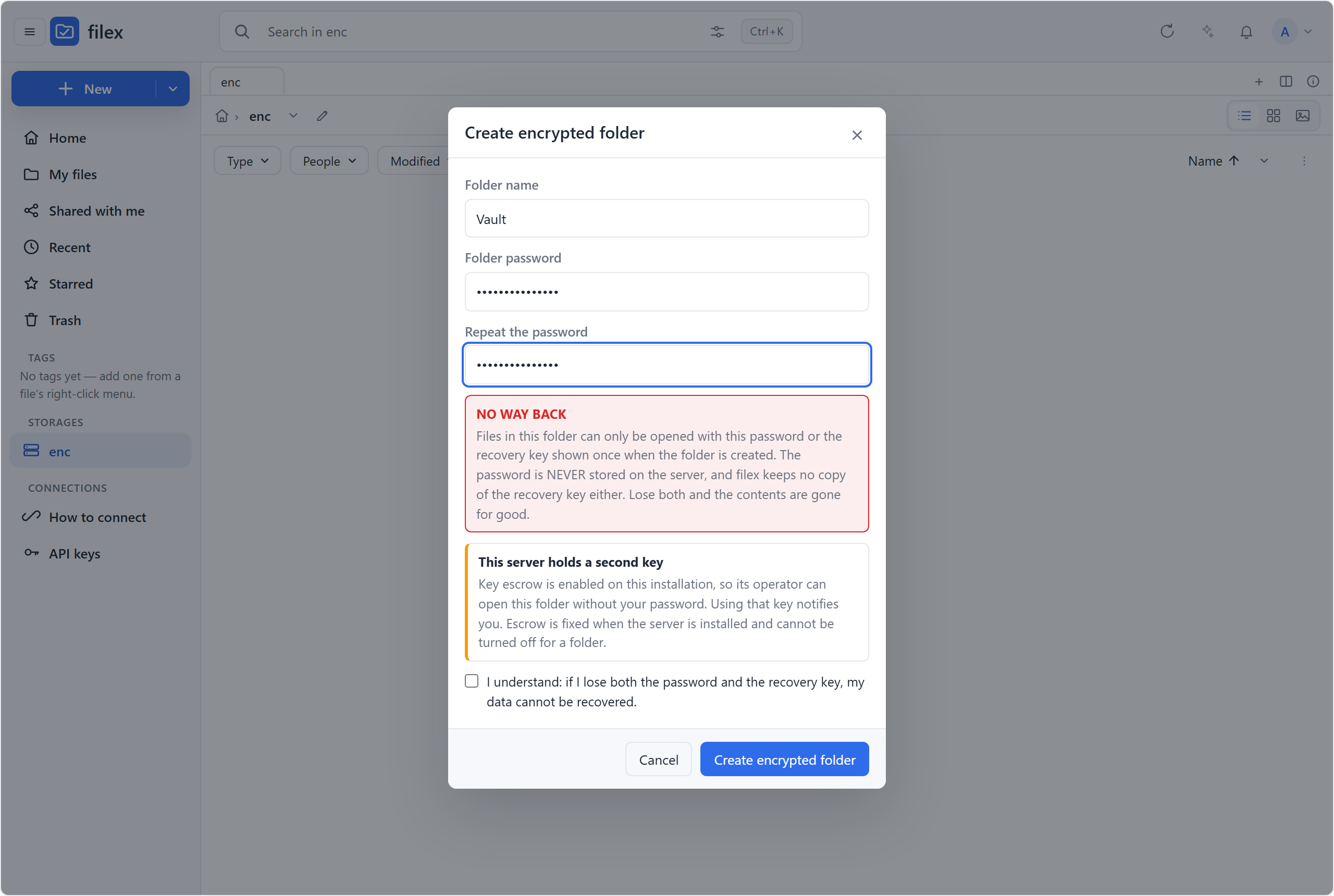 | 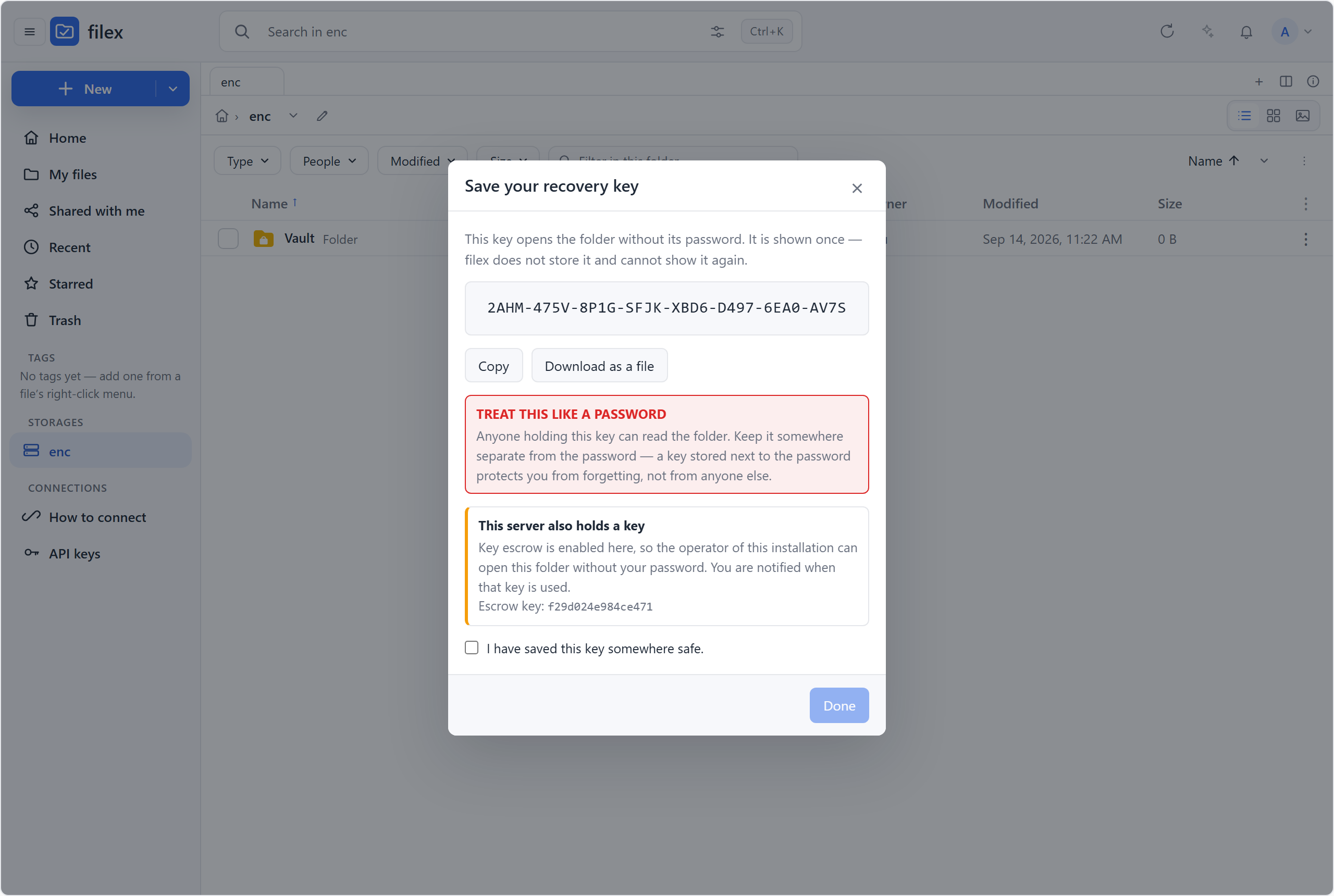 |
| Creating the folder. The escrow notice appears only when the installation has escrow on. | The recovery key, shown once. The dialog will not close until you tick that you saved it. |
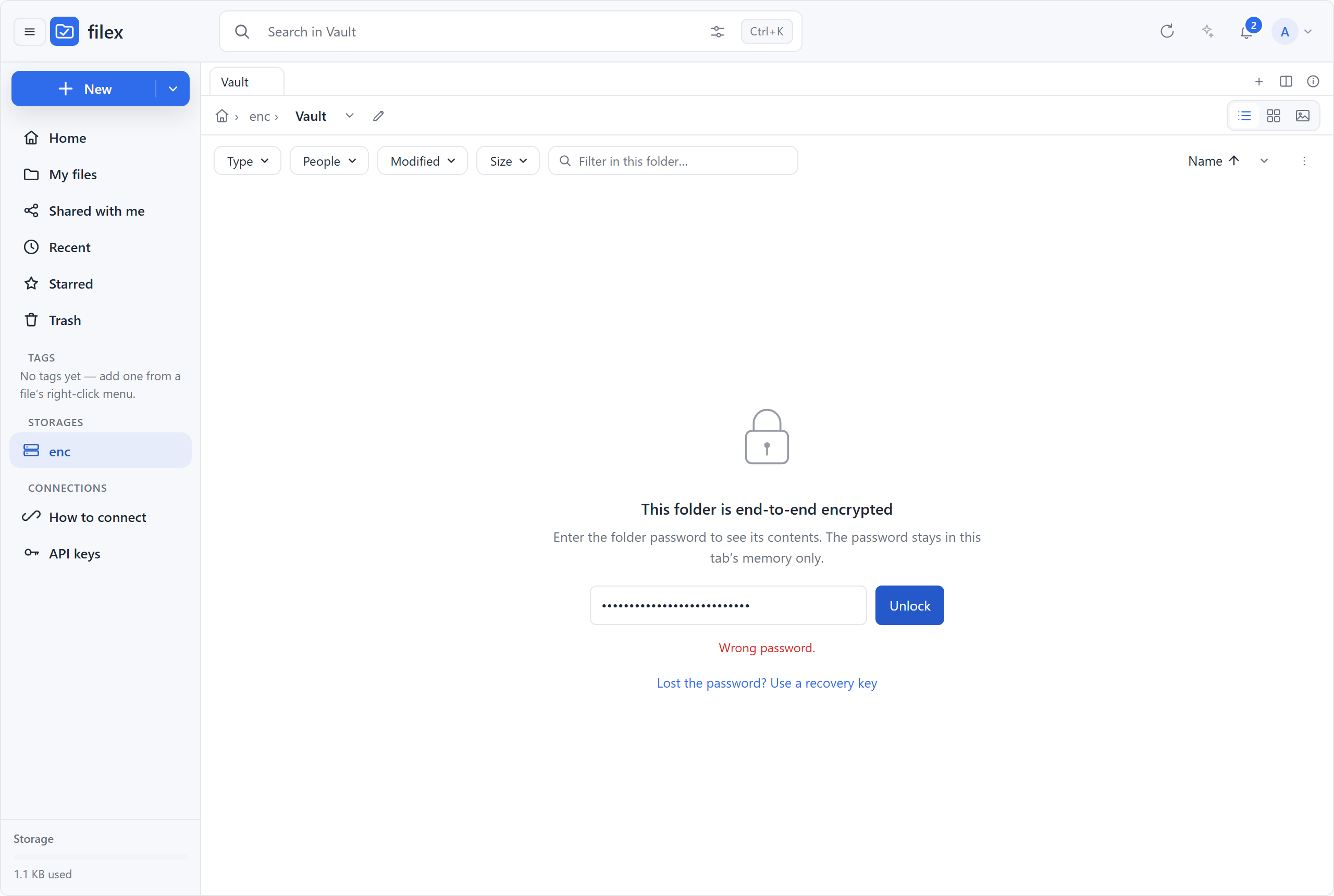 | 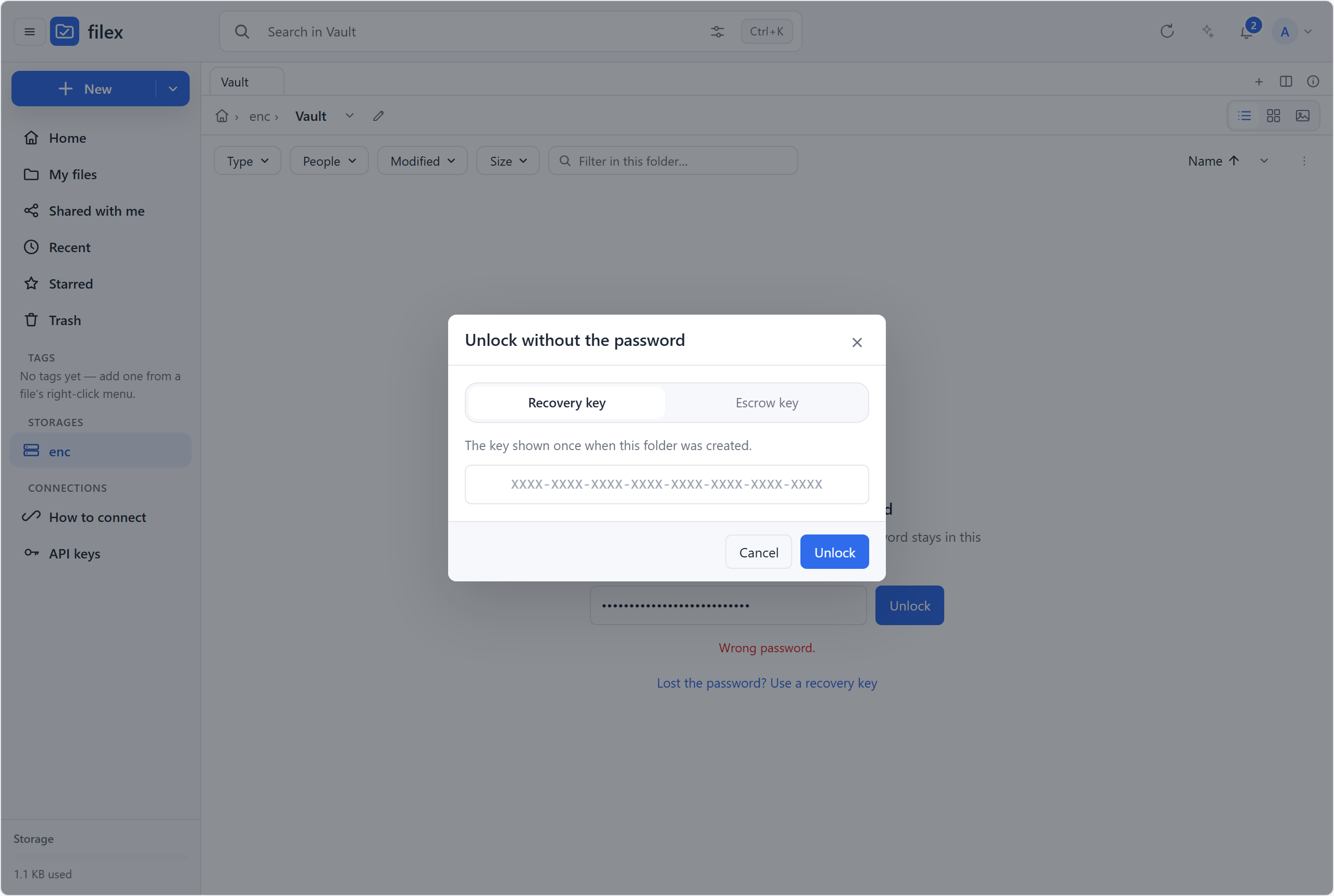 |
| A wrong password, and the way out underneath it. | The recovery-key dialog. The Escrow key tab appears only when both the installation and the folder have escrow. |
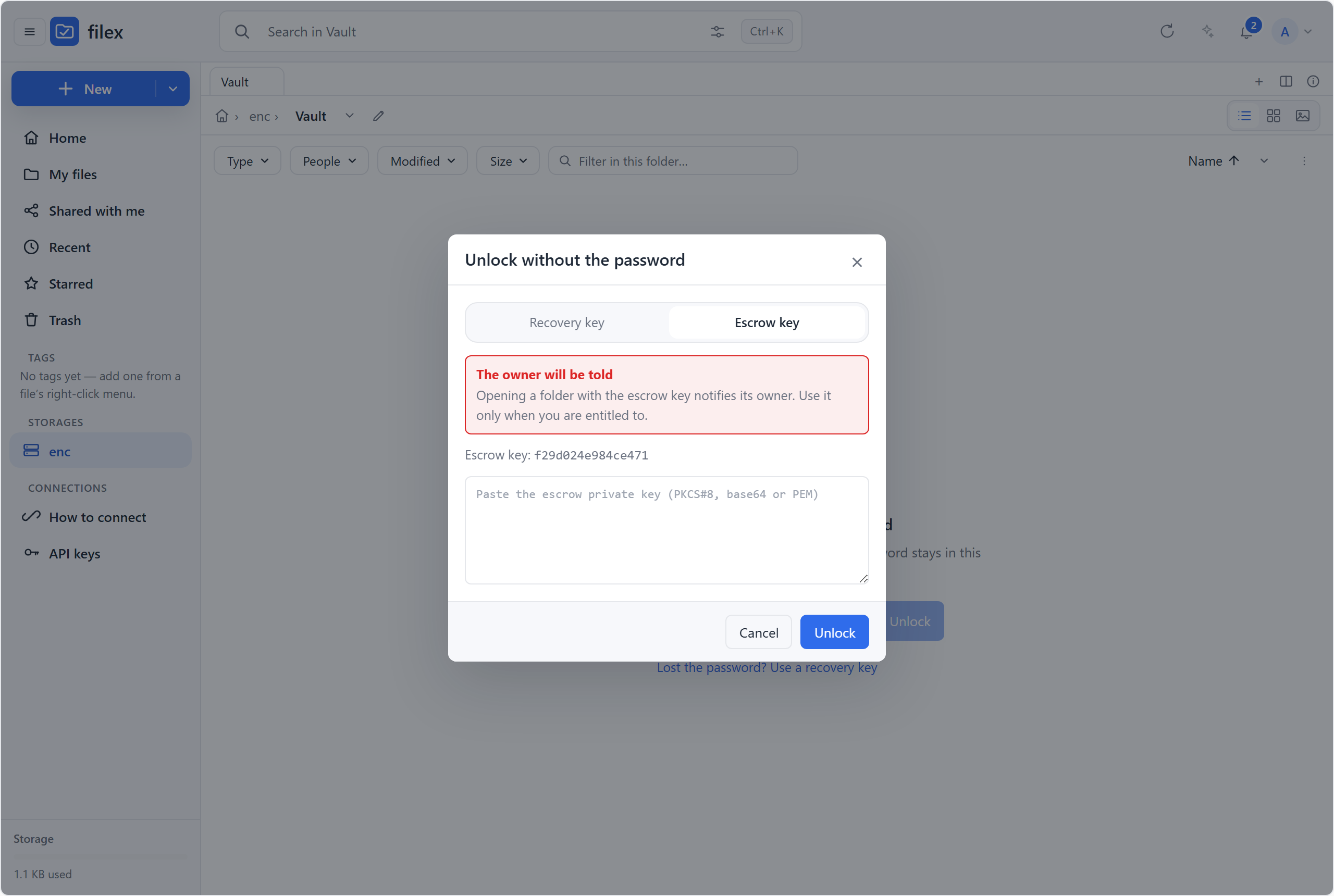 | 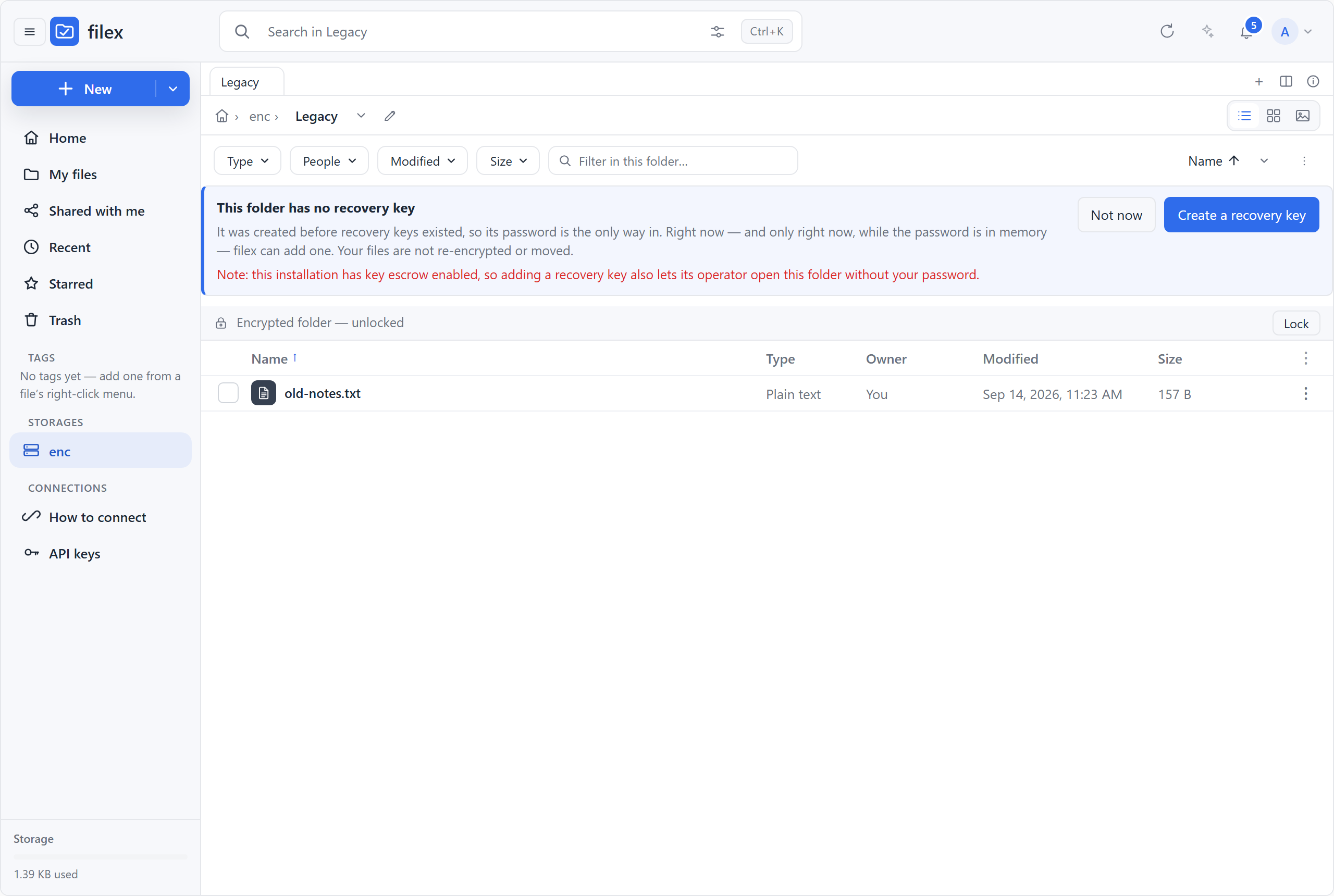 |
| Escrow says up front that the owner will be told. | A folder from before v0.31, just opened by password: the offer is visible, and it discloses the escrow consequence. |
Retake them with node e2e/shots/e2e-recovery.mjs --escrow-private <pkcs8-b64> against an instance booted with escrow on. The same script is the end-to-end measurement of this feature: it creates the folder, loses the password, gets back in with the key, and checks the notification arrived.
What the server knows
There is no encryption or decryption anywhere in the backend. The server only carries awareness of the two artifacts the client leaves behind, so that pipelines stop doing pointless — and potentially leaky — work:
internal/e2e— the marker name, the magic prefix,HasMagicPrefix(), and the ancestor walk (FindRoot()/UnderEncrypted()) that answers "is this path inside a folder carrying.filex-e2e.json?" via a path-hash lookup.- Thumbnails (
internal/thumb/pipeline.go) — files under a marked subtree are recorded asskipped. - Content indexing (
internal/queue/content_index.go) — the marker itself is never eligible; anything under a marked subtree is indexed with empty content; and a magic sniff catches encrypted files that escaped the subtree walk (moved out, or marker deleted later). Empty content is indexed rather than nothing, so the fingerprint records and the node stops re-queueing. - OnlyOffice config (
internal/api/handlers/onlyoffice.go) — magic sniff →415 file is e2e-encrypted. - Listings (
internal/api/handlers/manager.go) — the marker row is hidden from every listing projection; encrypted directory rows are badgede2e: true; and a listing inside an encrypted subtree carriese2eande2e_rootso the client knows to show the lock screen. A cold-cache fallback flags a freshly created folder straight from the driver listing, before the sync run has cached it. - Search (
internal/api/handlers/search.go) — the marker is filtered out of tag listings, index hits and the SQLLIKEfallback alike. - The transfer guard (
internal/e2e/guard.go) — refuses a copy or move that would cross an encryption boundary, from any surface. It compares ancestor markers; it never opens a file. - Escrow, public half only (
internal/e2e/escrow.go,internal/api/handlers/e2e.go) — the installation's escrow public key, published in/api/capabilitiesso the browser can seal new folders to it, and used to seal a challenge nonce so that "the escrow key was used" is provable rather than merely asserted. The server has no private key and cannot open anything. - The install pin (
internal/e2e/installation.go) — records at first boot whether escrow is on and which key, and refuses to start if that later disagrees with the environment.
Every one of these is in the category "don't do useless work, and don't open a leak" — none of them can read a byte of your content.
Not implemented
These are known gaps, not scheduled work. They are listed because each one is a limitation you can hit today:
- Encrypted names. File and folder names are stored in the clear (see the threat model).
- Sharing an encrypted folder. There is no way to hand a recipient a link that also carries the key, so sharing is simply off.
- Files over 200 MB. Encryption is one-shot in memory. The 16 reserved header bytes exist so a chunked format could be added without breaking the layout, but no chunked format exists.
- Changing the folder password. The v2 marker makes it cheap for a folder created since v0.31 — re-wrap
fmk_pw, touch no file. For a folder upgraded from v1 (fmk: "kek") it is not cheap: the FMK is the password-derived key, so changing the password means re-wrapping every file's DEK. Neither flow exists. The only way to change a password today is to create a new encrypted folder and re-upload. - Rotating or revoking a recovery key. A recovery key is minted once and lives as long as the folder. There is no "show me a new one" and no way to invalidate a key you think leaked, short of moving the files into a new encrypted folder.
- Escrow at the folder level. Escrow is per-installation and per-folder only in the sense that it applies to folders created after it was enabled. A user cannot opt a folder out, and an operator cannot escrow one folder and not another.
- Detecting offline escrow use. The notification covers the supported path only. See what escrow can and cannot do.
- Editing files in place. Preview is read-only inside an encrypted folder.
- A server-side guard against plaintext writes over DAV / CLI / ShareX / AI. Copy and move are guarded now; a direct write through those surfaces is not — see Ways plaintext still reaches the server.
- Re-encrypting on move. filex refuses a transfer across an encryption boundary rather than re-encrypting or decrypting the bytes, because it holds no key to do either with. Move the file by downloading and re-uploading it.
See also
- SEARCH.md — name vs. content search, and the content index
- SHARING.md — share links and file requests (both off here)
- thumbnails.md — the thumbnail pipeline and its skip states
- PROTOCOLS.md / WEBDAV.md — the non-web surfaces that write plaintext
- TRASH-VERSIONING.md — both keep working on ciphertext
- RBAC.md — permissions, which are independent of encryption
- CONFIGURATION.md —
FILEX_INSTALLATION_E2E_ESCROW_KEYand why install-time settings are frozen